

Bali has a steady stream of Americans: guests at villas in Ubud and Seminyak, remote workers in Canggu’s coworking spaces, and the brands and agencies that hire creators in Jakarta. Whether they are booking a stay or a video, many of them would rather call a +1 number than an international one. The catch is the clock. Here is when the US working day reaches Indonesia, how a US number fits each kind of work, and why voicemail does so much of the work here.
When do Indonesian and US hours overlap?
Barely, so plan around the edges of the day. Indonesia has three time zones and none of them change their clocks: Western Indonesia Time (WIB, Jakarta and the rest of Java and Sumatra) is UTC+7, Central Indonesia Time (WITA, Bali, Lombok and Sulawesi) is UTC+8, and Eastern Indonesia Time (WIT, Maluku and Papua) is UTC+9 (IANA). US Eastern time is UTC-4 in the US summer and UTC-5 in the US winter, Central is an hour behind Eastern and Pacific three hours behind (NIST).
Here is a US working day, 9 a.m. to 5 p.m., in Jakarta and Bali time:
| Your client is in | Jakarta, US summer | Jakarta, US winter | Bali, US summer | Bali, US winter |
|---|---|---|---|---|
| Eastern (New York, Boston, Miami) | 8 p.m. to 4 a.m. | 9 p.m. to 5 a.m. | 9 p.m. to 5 a.m. | 10 p.m. to 6 a.m. |
| Central (Chicago, Dallas, Houston) | 9 p.m. to 5 a.m. | 10 p.m. to 6 a.m. | 10 p.m. to 6 a.m. | 11 p.m. to 7 a.m. |
| Pacific (Los Angeles, San Francisco, Seattle) | 11 p.m. to 7 a.m. | Midnight to 8 a.m. | Midnight to 8 a.m. | 1 a.m. to 9 a.m. |
In Maluku and Papua, add one hour to the Bali columns.
That leaves two usable windows. The evening window reaches the East Coast’s morning: 8 to 10 p.m. in Jakarta or 9 to 11 p.m. in Bali in the US summer, an hour later in the US winter. The early-morning window reaches the West Coast’s afternoon of the day before: in Bali, 6 to 8 a.m. is 3 to 5 p.m. in California in the US summer, and 7 to 9 a.m. in the US winter. In Jakarta, take an hour off those times. So your Saturday morning is still Friday afternoon in Los Angeles.
US clocks go back on November 1, 2026 and forward on March 14, 2027, and each time both windows move by an hour. The US time-zone clock shows each zone right now.
How does a US number work from Indonesia?
The TripoSIM US Virtual Number runs in the TripoSIM app over Wi-Fi or mobile data, so a villa’s Wi-Fi, a coworking space or a local SIM with data all do the job. On iPhone, add the TripoSIM web app to your Home Screen. On Android, install the TripoSIM app. You need an email address, a payment card and a short ID check with a photo ID and a selfie, about 2 minutes. You do not need a US address or an SSN.
Before you rely on it, one check matters. Rules on internet calling differ by country, and a call on the number is an internet call on your network. Check with your regulator or mobile operator, and keep your Indonesian number for calls inside Indonesia.
Texts work differently. A text from a US sender reaches your number in the US and appears in the app over your connection, and verification codes from apps arrive the same way.
Which setup fits your work?
Villa and guesthouse hosts. American guests often call before they book, to ask about the airport transfer, the drive up to Ubud or whether the pool is private. A +1 number on your website and booking emails makes that an ordinary call for them, and voicemail takes the calls that arrive while you sleep. The tour operators and hotels page covers inquiry lines. If you also host a place back in the US, the vacation hosts page covers Airbnb verification and calls from US cleaners.
Digital nomads in Bali. Swap SIMs as often as you like; the US number stays the same, so clients, family and app sign-ins keep one number for you. A local SIM or travel eSIM gives you data and the app gives you the number. The digital nomads page and the nomad phone setup walk through it.
Freelancers and creators. Video editors, designers and creators in Jakarta and Bali who work with US brands can put a +1 number in their media kit for the brand manager who wants a quick call before a deal. TikTok, Instagram and Google sent codes to a TripoSIM number in TripoSIM’s tests on October 3, 2026; keep your profiles set to your real country. The creators page has more.
How many minutes does a typical month use?
Take Wayan, a made-up example: he runs two villas in Ubud and gets most of his American bookings by phone. In a busy month, about 45 guests call him for 5 minutes each, mostly while he sleeps. Those 225 minutes come from the incoming allowance, a fair use of 300 minutes a month, and do not touch his outgoing minutes. If calls to him ever pass that fair use, callers reach voicemail until the next month.
Each morning he plays his voicemails and calls back about six guests a week for 4 minutes each. That is 24 minutes a week, or about 105 minutes a month, well inside the 300 minutes a month to the US and Canada. Each outgoing call is rounded up to the next full minute; unanswered calls are free. So guests who do not pick up cost him nothing, and he tries again in the evening window. The cost calculator works out your own month.
What should your contact page and voicemail say?
Most American callers will reach your voicemail first, so the page and the greeting have to say when you call back:
Call us from the US: +1 (your number). (Villa name), Ubud, Bali. I return calls every day, 3 to 5 p.m. Pacific or 9 to 11 a.m. Eastern. Leave a voicemail with your dates and your number, or email (your address).
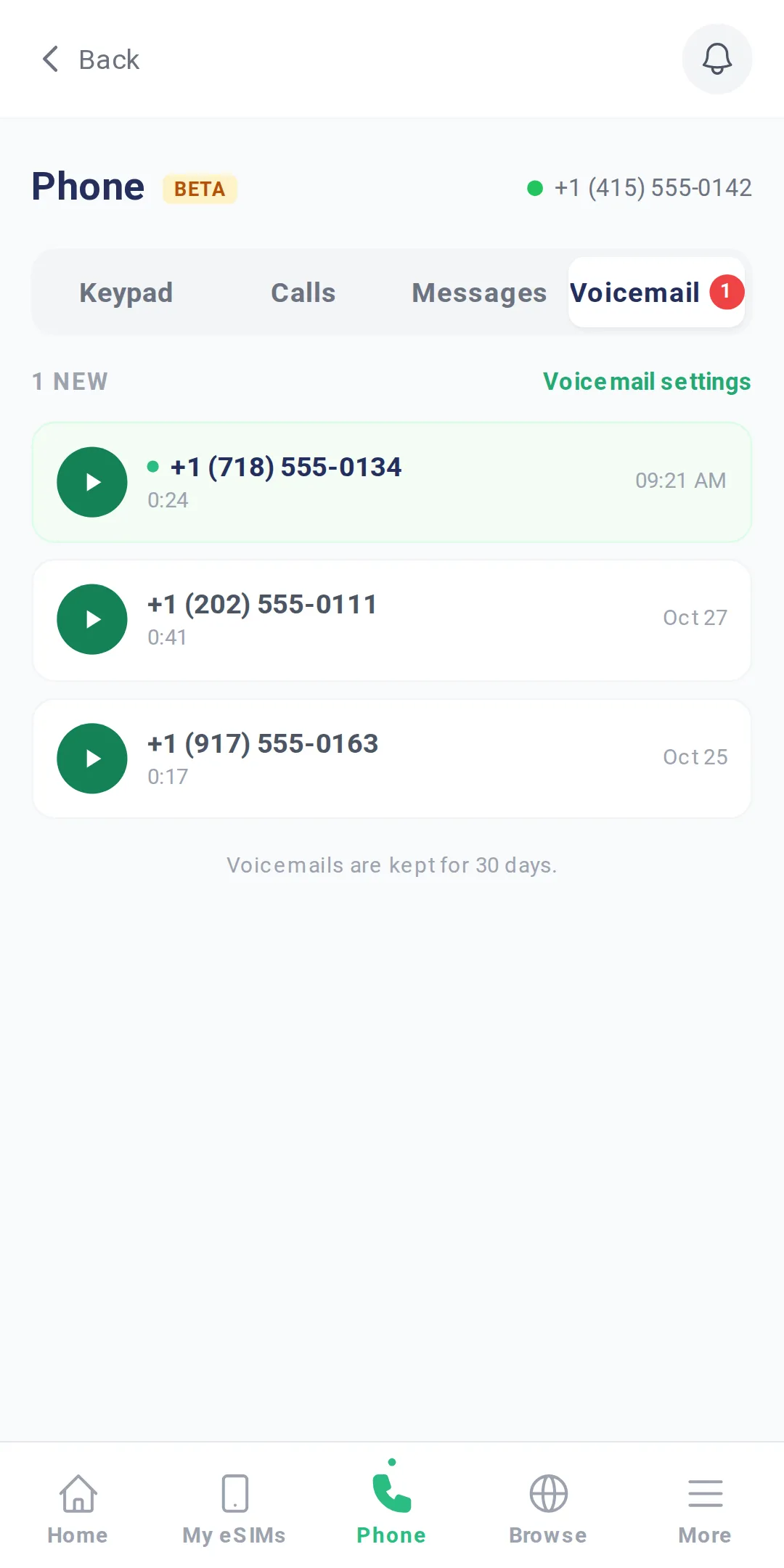
Write “call or email”, not “call or text”. A US area code makes you easy to call; it does not give you a US office, so name your real place. Messages can be up to 2 minutes, up to 30 a month, kept 30 days. In a busy month, check them every morning so none expire unheard. The voicemail guide covers setup.
What can’t the number do?
- No sending texts. It receives texts only. For chat, guests and clients can use email or WhatsApp, which you can set up on the same US number.
- No calls out beyond the US and Canada. Use your Indonesian line for local numbers.
- No 911. It cannot call 911 or any emergency service, so keep your Indonesian number for emergencies.
- No internet, no ring. If the villa Wi-Fi drops, callers reach voicemail. Keep mobile data on as a backup.
The bottom line
From Indonesia, plan East Coast calls in your evening, from 8 p.m. in Jakarta or 9 p.m. in Bali in the US summer, and West Coast calls in your early morning, when it is still the afternoon before in California. Give American guests, clients and brands a +1 number with your call-back hours in their time zone, and let voicemail cover the night. Check the rules on internet calling first, then test calls with the ten-check reliability test. The plans page has both plans: $100 a year or $12.99 a month.