

Nepal’s 45-minute offset catches out even people who schedule US calls every week. If you run a trekking agency in Thamel, write code for US startups from Lalitpur or have a place at a US university for the autumn, your American contacts are starting their day as yours ends. Here is how the hours line up, how a +1 number fits each of those jobs, and what to check before you rely on it.
When do Kathmandu and US working hours overlap?
Nepal is UTC+5:45 all year, fifteen minutes ahead of India, and does not change its clocks (IANA tz database). US Eastern time is UTC-5 in winter and UTC-4 in summer, Central is an hour behind Eastern and Pacific three hours behind, and US summer runs from the second Sunday in March to the first Sunday in November (NIST).
Here is a US working day, 9 a.m. to 5 p.m., in Kathmandu time:
| Your contact is in | US summer, Kathmandu time | US winter, Kathmandu time |
|---|---|---|
| Eastern (New York, Washington, Atlanta) | 6:45 p.m. to 2:45 a.m. | 7:45 p.m. to 3:45 a.m. |
| Central (Chicago, Dallas, Houston) | 7:45 p.m. to 3:45 a.m. | 8:45 p.m. to 4:45 a.m. |
| Pacific (Los Angeles, San Francisco, Seattle) | 9:45 p.m. to 5:45 a.m. | 10:45 p.m. to 6:45 a.m. |
So the useful window is your evening: about 6:45 to 9:45 p.m. Kathmandu time for New York’s morning in the US summer, and 7:45 to 10:45 p.m. in the US winter. West Coast mornings start at 9:45 or 10:45 p.m. your time, so keep one late evening a week for them.
The 45 minutes matter when you set a call by hand. A client who says “let’s talk at 10 Eastern” means 7:45 p.m. in Kathmandu from mid-March to early November and 8:45 p.m. in the US winter. Send invitations from a calendar that shows both zones, and write times in the caller’s zone in emails. US clocks go back on November 1, 2026 and forward on March 14, 2027, and each time your evening window moves by an hour. The US time-zone clock shows each zone right now.
How does a US number work from Nepal?
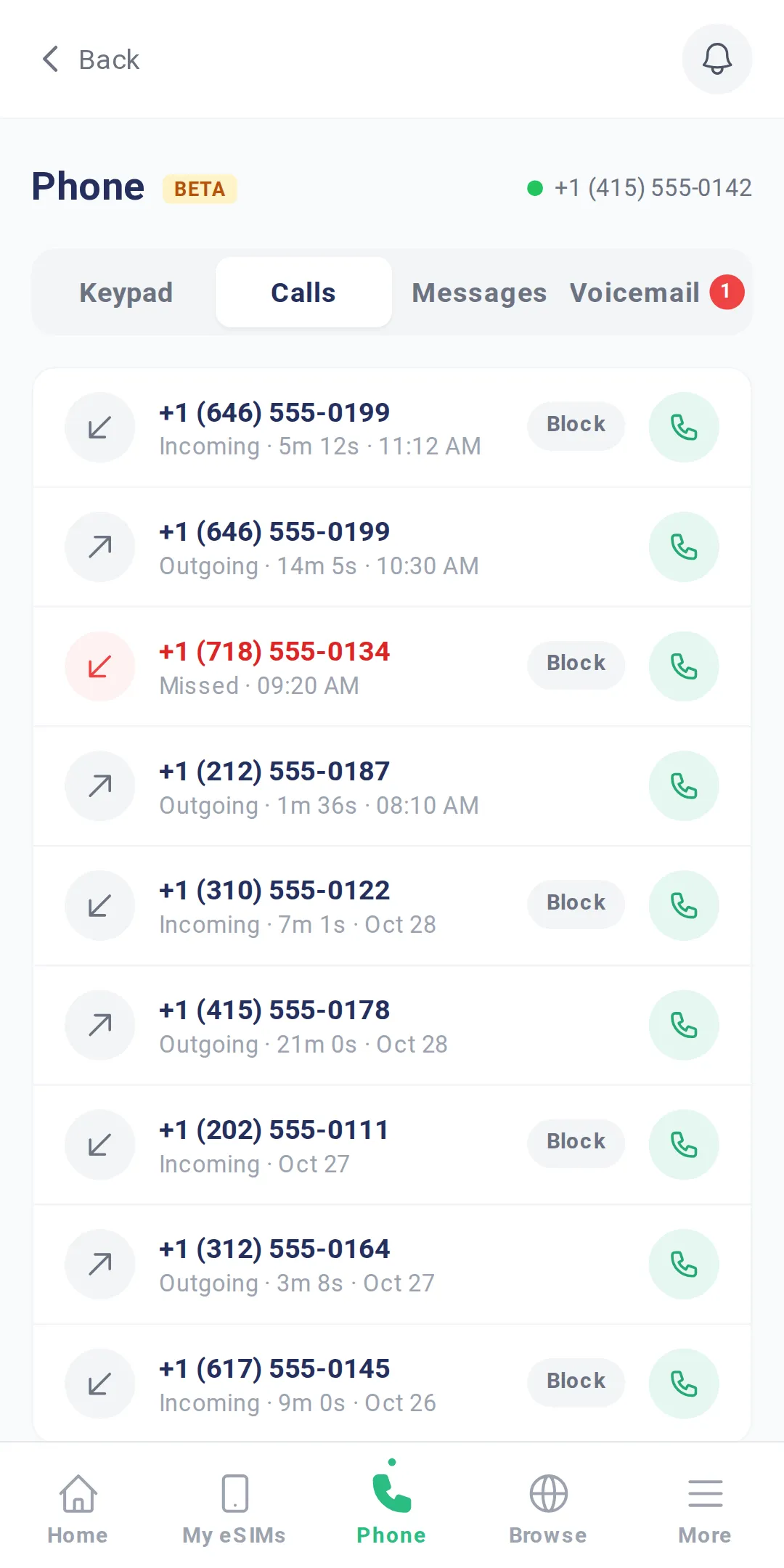
The TripoSIM US Virtual Number runs in the TripoSIM app over Wi-Fi or mobile data. On iPhone, add the TripoSIM web app to your Home Screen. On Android, install the TripoSIM app. You need an email address, a payment card and a short ID check with a photo ID and a selfie, about 2 minutes. You do not need a US address or an SSN.
Before you rely on it, one check matters. Rules on internet calling differ by country, and a call on the number is an internet call on your network. Check with your regulator or mobile operator, and keep your Nepali number for calls inside Nepal.
Texts from US senders reach your number in the US and appear in the app over your connection, and verification codes from apps arrive the same way. If you guide treks yourself, remember that the app rings only where you have Wi-Fi or data. Out on the trail without a connection, calls go to voicemail, so say in your greeting when you will be back online.
Which setup fits your work?
Trekking and tour agencies. Americans planning a trek want to talk before they pay: what the price includes, how fit they need to be, airport pickups, and what happens if a mountain flight is delayed. A +1 number on your website and booking emails makes that an ordinary US call. Most inquiries come in the months before the spring and autumn seasons, so expect busier months and plan your minutes for them. Once guests land in Kathmandu, switch to your Nepali number or WhatsApp. The tour operators page covers inquiry lines and busy-season limits.
Freelancers. Developers, designers and writers working for US clients can put one +1 number on their profile and invoices, with hours in Eastern or Pacific time. Upwork, Fiverr and Payoneer sent codes to a TripoSIM number in TripoSIM’s tests on October 3, 2026; keep your profiles set to your real country. See the freelancers page and a second US number for freelancers.
Students heading to the US. A +1 number before you fly gives landlords, roommates and campus offices a number they will call during the months of paperwork and flat-hunting. Their working day is your evening, so an East Coast landlord’s 10 a.m. call reaches you after dinner in Kathmandu. The students page and the before-you-move checklist cover what to sort out before you leave and after you land.
How many minutes does a busy season use?
Take Sujan, a made-up example: he runs a small trekking agency in Thamel. In the busy months before each season, American trekkers call or leave voicemails, and he calls back about 12 of them a week, for about 6 minutes each. Each outgoing call is rounded up to the next full minute; unanswered calls are free. So a call of 5 minutes and 20 seconds counts as 6.
That is 72 minutes a week, about 312 minutes a month, a little past the 300 minutes a month to the US and Canada. In those months he needs one extra pack of 100 minutes at $5. In the quiet monsoon months he calls back three trekkers a week, about 78 minutes a month. Top-up minutes are used after your monthly minutes, stay valid while your number is active and carry over when you renew. They are not refundable. So he buys his pack a few weeks before the season starts, and any minutes he does not use stay with him. Calls trekkers make to him do not use his minutes; they come from a separate fair use of 300 minutes a month. The cost calculator works out your own season.
What should your contact page and voicemail say?
Say where you are and when you answer, in your caller’s time zone:
US line: +1 (your number). (Name), (agency), Kathmandu, Nepal. I take calls Monday to Friday, 9 a.m. to noon Eastern. If I am out on a trek, leave a voicemail and I will call back within two US working days, or email (your address).
Write “call or email”, not “call or text”. A US area code makes you easy to call; it does not give you a US office, so give your real city. Voicemail messages can be up to 2 minutes, up to 30 a month, kept 30 days. The voicemail guide and the business contact checklist have more.
What can’t the number do?
- No sending texts. It receives texts only. For written messages, use email or WhatsApp, which you can set up on the same US number.
- No calls out beyond the US and Canada. Use your Nepali line for Nepali numbers.
- No 911. It cannot call 911 or any emergency service, so keep your Nepali number for emergencies.
- No internet, no ring. If your connection drops, callers reach voicemail. Give clients and guests email as the backup.
The bottom line
From Nepal, plan US calls in your evening: about 6:45 to 9:45 p.m. for New York in the US summer, an hour later in the US winter, and later still for California, and let a calendar handle the 45 minutes. Give American trekkers, clients and landlords a +1 number with your hours in their time zone, buy top-up minutes ahead of the busy season, and let voicemail cover your night and your days on the trail. Check the rules on internet calling first, then test calls with the ten-check reliability test. For other countries, see US phone numbers by country. The plans page has both plans: $100 a year or $12.99 a month.