

Morocco shares more of the US working day than most of Africa and the Arab world, and it shows on the clock. A freelancer in Rabat, a riad owner in the Marrakech medina or a desert-tour company in Merzouga can take American calls in the afternoon and still finish at a normal hour. Here is how the hours line up, including the one month a year when they shift, and how a US number fits each kind of work.
When does Morocco overlap with the US?
In your afternoon and early evening. Morocco’s usual time is UTC+1, but it sets its clocks back to UTC+0 for about a month around Ramadan each year. The dates are announced each year; for 2027, the IANA time zone database expects the UTC+0 period from about February 7 to March 14 (IANA). US Eastern time is UTC-4 in the US summer and UTC-5 in the US winter, Central is an hour behind Eastern and Pacific three hours behind (NIST).
Here is a US working day, 9 a.m. to 5 p.m., in Morocco time:
| Your client is in | US summer, Morocco time | US winter, Morocco time | Ramadan period 2027, Morocco time |
|---|---|---|---|
| Eastern (New York, Boston, Miami) | 2 p.m. to 10 p.m. | 3 p.m. to 11 p.m. | 2 p.m. to 10 p.m. |
| Central (Chicago, Dallas, Houston) | 3 p.m. to 11 p.m. | 4 p.m. to midnight | 3 p.m. to 11 p.m. |
| Pacific (Los Angeles, San Francisco, Seattle) | 5 p.m. to 1 a.m. | 6 p.m. to 2 a.m. | 5 p.m. to 1 a.m. |
The two clocks move for different reasons. In the US winter, New York is six hours behind Morocco. When the US moves to summer time, the gap shrinks to five hours. During Morocco’s Ramadan hour, Morocco steps back too, and the gap returns to five hours. In 2027 that period falls inside the US winter, so for those weeks use the right-hand column.
So the best window is 2 to 5 p.m. for New York in the US summer and during the Ramadan weeks, and 3 to 6 p.m. the rest of the US winter. West Coast clients start at 5 or 6 p.m. your time. US clocks go back on November 1, 2026 and forward on March 14, 2027. Re-check the US time-zone clock when Morocco announces its Ramadan dates and on each US change.
Does an app-based US number work in Morocco?
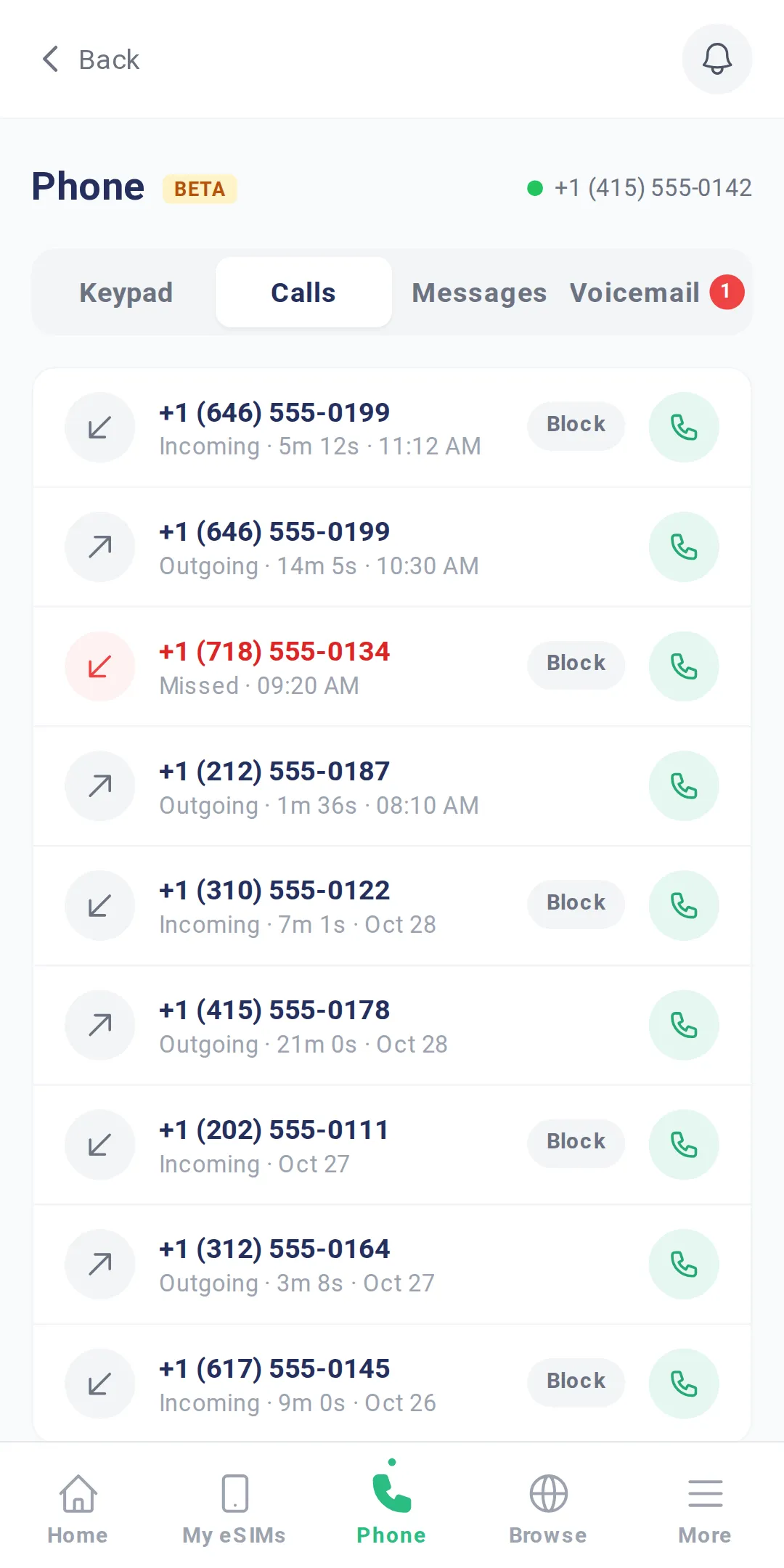
The TripoSIM US Virtual Number runs in an app over Wi-Fi or mobile data. On iPhone, add the TripoSIM web app to your Home Screen. On Android, install the TripoSIM app. You sign up with an email address, a payment card and a short ID check with a photo ID and a selfie, about 2 minutes. You do not need a US address or an SSN.
- Rules differ by country. On your network, a call on the number is an internet call. Before you rely on calls, check the rules on internet calling with your regulator or mobile operator, and keep your Moroccan SIM for calls at home.
Texts work differently. A text from a US sender reaches your number in the US and shows up in the app over your connection, and verification codes from apps arrive the same way.
Who in Morocco uses a US number?
- Freelancers in support and account work. If you handle customer support, account management or virtual assistance for a US or Canadian company in English or French, a +1 number lets clients call you directly. It is one person’s line for personal and small-business use, and call centers are not allowed. A company that wants a team in Casablanca answering one line needs a business phone system; see US numbers for remote teams.
- Riad and guesthouse hosts. American guests often want to ask about airport pickup, the walk through the medina or dinner on the roof before they book. A +1 number on your website and booking emails makes that an ordinary call for them. The tour operators and hotels page covers inquiry lines.
- Tour operators. Travel agents in the US who sell desert, Atlas or imperial-city trips can call you about a group without an international call. Put the number on your trade sheet with your hours in Eastern time.
- Exporters. Argan oil, ceramics, rugs and textiles go to US buyers who want a quick word about samples and shipping. One person can hold several numbers, each with its own plan, for example one per brand. See importers and exporters.
How many minutes does a typical month use?
Take Salma, a made-up example: a freelance account manager in Rabat with one client in Boston and one in Montreal. She has a 10-minute check-in with Boston every weekday at 9 a.m. Eastern, which is 2 or 3 p.m. in Rabat depending on the season. That is 50 minutes a week, or about 215 minutes a month. A monthly 30-minute call with Montreal, in French, takes her to about 245 minutes.
Both clients are covered by the same 300 minutes a month, because calls to Canada are included. Each outgoing call is rounded up to the next full minute; unanswered calls are free. So when a check-in goes unanswered and she tries again later, the first attempt costs nothing. Calls her clients make to her come from a separate fair use of 300 minutes a month. If a busy month pushes her over, extra minutes cost $5 per 100. The cost calculator works out your own month.
What should your contact page and greeting say?
For a riad or tour company, say who answers and when, in the guest’s time:
Call us from the US: +1 (your number). (Riad name), Marrakech. I answer every day from 9 a.m. to 1 p.m. Eastern. Leave a voicemail at any time with your dates, or email (your address), and I will call you back.
Write “call or email”, not “call or text”. A US area code makes you easy to call; it does not give you a US office, so say you are in Morocco. Record the greeting in English and, if you have French-speaking guests or clients, in French too. Messages can be up to 2 minutes, up to 30 a month, kept 30 days. The voicemail guide covers setup.
What can’t the number do?
- No sending texts. It receives texts only. For chat, guests and clients can use email or WhatsApp, which you can set up on the same US number.
- No calls to Moroccan numbers. Calls out go to US and Canadian numbers only, so keep your Moroccan line for local calls.
- No 911. It cannot call 911 or any emergency service, so keep your Moroccan number for emergencies.
- Not a team line. One person answers it. In a busy season, if calls to you pass 300 minutes in a month, callers reach voicemail until the next month.
The bottom line
From Morocco, call New York between 2 and 5 p.m. in the US summer and during the Ramadan weeks, and between 3 and 6 p.m. the rest of the US winter. West Coast calls fit your early evening. Publish a +1 number with your hours in Eastern time and “call or email”, and re-check the clock when Morocco announces its Ramadan dates. Check the rules on internet calling first, then test calls with the ten-check reliability test. The plans page has both plans: $100 a year or $12.99 a month.