

A pump maker near Stuttgart with a distributor in Ohio, a Berlin software company selling to mid-sized US firms, a Hamburg agency with a client in Austin, an American who moved to Munich for work: each of them has a US working day that starts in their mid-afternoon. Here is how the hours line up, the weeks each year when they shift, how a +1 number fits each case, and what to check first.
When do German and US working hours overlap?
Germany is on Central European Time (UTC+1) in winter and Central European Summer Time (UTC+2) in summer. It changes its clocks on the last Sunday in March and the last Sunday in October, as the rest of the EU does (IANA tz database). US Eastern time is UTC-5 in winter and UTC-4 in summer, Central is an hour behind Eastern and Pacific three hours behind, and US summer runs from the second Sunday in March to the first Sunday in November (NIST).
Here is a US working day, 9 a.m. to 5 p.m., in Berlin time:
| Your US customer is in | Berlin time, most of the year | Berlin time, in the mismatch weeks |
|---|---|---|
| Eastern (New York, Boston, Charlotte) | 3 p.m. to 11 p.m. | 2 p.m. to 10 p.m. |
| Central (Chicago, Milwaukee, Houston) | 4 p.m. to midnight | 3 p.m. to 11 p.m. |
| Pacific (Los Angeles, San Francisco, Seattle) | 6 p.m. to 2 a.m. | 5 p.m. to 1 a.m. |
If your day ends at 6 p.m., you share three hours with New York and two with Chicago. Put the calls that need a decision early in that window: by 6 p.m. your time it is noon in New York and the US side is heading into lunch and meetings. A West Coast morning is 6 to 9 p.m. your time, so most firms in Germany cover it with one or two fixed evenings a week and voicemail for the rest. Your morning is the US night; use it for email, quotes and the work itself.
Which weeks does the gap shrink to five hours?
The US and Germany both use summer time, but they switch on different Sundays: the US on the second Sunday in March and the first Sunday in November, Germany on the last Sunday in March and the last Sunday in October. In the weeks between, Berlin is five hours ahead of New York instead of six. Here is the year ahead:
| Dates | What is happening | New York’s 9 a.m. in Berlin | Los Angeles’ 9 a.m. in Berlin |
|---|---|---|---|
| November 1, 2026 to March 13, 2027 | Both on winter time | 3 p.m. | 6 p.m. |
| March 14 to 27, 2027 | US on summer time, Germany not yet | 2 p.m. | 5 p.m. |
| March 28 to October 30, 2027 | Both on summer time | 3 p.m. | 6 p.m. |
| October 31 to November 6, 2027 | Germany back on winter time, US not yet | 2 p.m. | 5 p.m. |
| From November 7, 2027 | Both on winter time | 3 p.m. | 6 p.m. |
This autumn’s short week has just ended: German clocks went back on October 25, 2026 and US clocks went back on November 1, 2026, so the six-hour gap is back until March 14, 2027.
In those weeks, a standing Friday call you set for 3 p.m. Berlin with a distributor in Ohio reaches them at 10 a.m. instead of 9, and a call they set for 9 a.m. their time appears at 2 p.m. on your calendar. If your US customers work to cut-off times, such as “orders by noon Eastern ship today”, that cut-off is 5 p.m. your time in those weeks, not 6. Put both time zones in every invite, agree whose clock a standing call follows, and check the calendar on the Monday after each change.
How does a US number work from Germany?
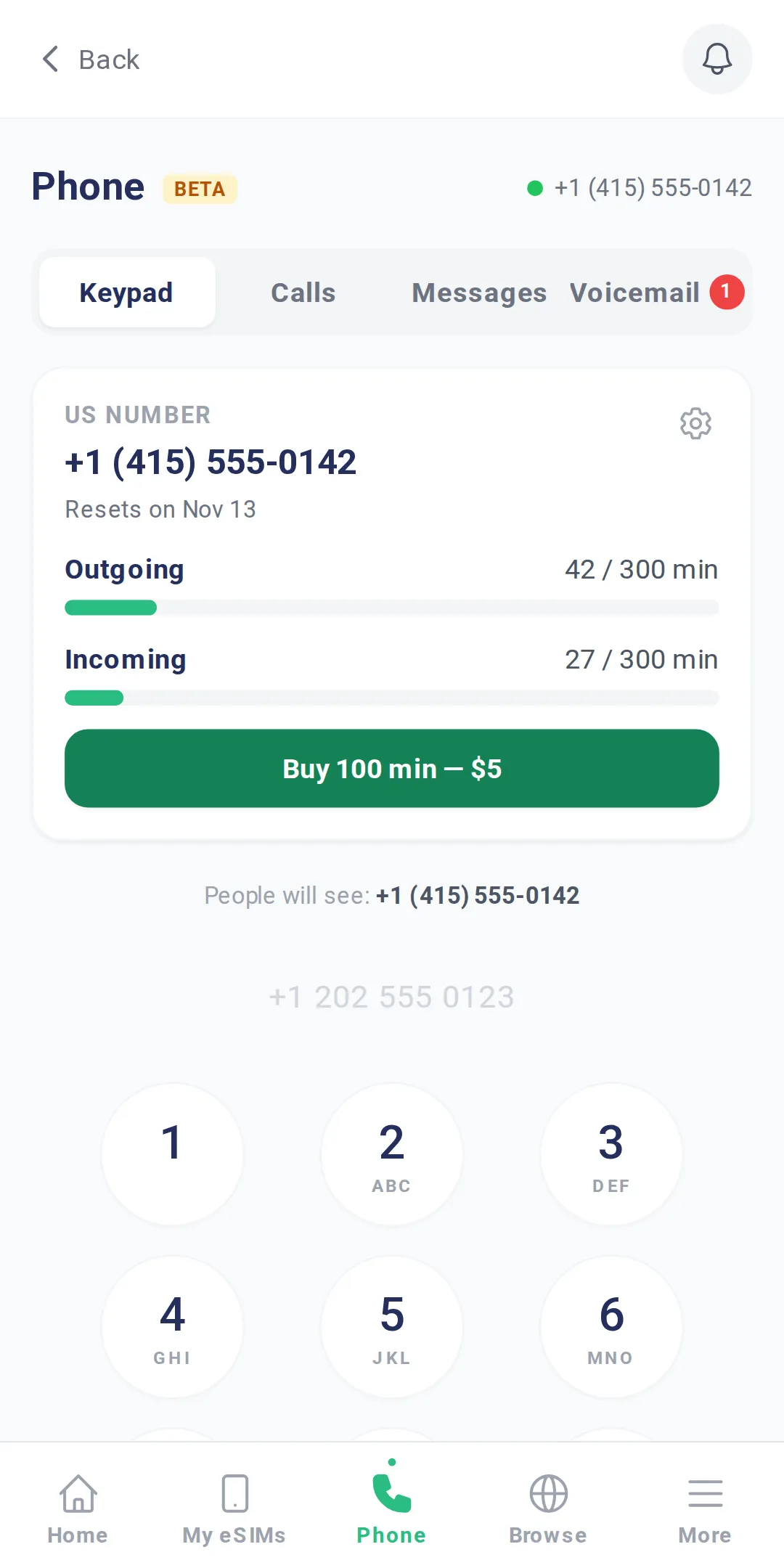
The TripoSIM US Virtual Number runs in the TripoSIM app over Wi-Fi or mobile data, on the same phone as your German line. On iPhone, add the TripoSIM web app to your Home Screen. On Android, install the TripoSIM app. You need an email address, a payment card and a short ID check with a photo ID and a selfie, about 2 minutes. You do not need a US address, an SSN or a US subsidiary.
Rules on internet calling differ by country, and on your network a call on the number is an internet call. Check with your regulator or mobile operator before you rely on calls, and keep your German number for calls inside Germany.
Texts from US senders reach your number in the US and appear in the app over your connection, and verification codes from apps arrive the same way. Microsoft and LinkedIn sent codes to a TripoSIM number in TripoSIM’s tests on October 3, 2026.
Which setup fits your business?
Exporters. A US distributor or end customer with a question about a part, a delivery or a quote often wants to call someone, not write to a general inbox. A +1 number on the quote, the order confirmation and your trade-show card makes that an ordinary call for them. Give each export sales manager their own number, app and ID check, so a customer reaches the person who knows the account. The number is not a service desk: a team of technicians answering one line needs a business phone system, which US numbers for remote teams explains.
Agencies and software firms. For a Berlin startup selling to US companies, a +1 number on the US pricing page and in the sales team’s email signatures makes the first call easier. Sales calls usually run on video and use no minutes; the phone covers the lead who wants a quick word first, or the customer whose video tool is down. One person can hold several numbers, each with its own plan, for example one per brand. The agencies page and how a US number helps you win US clients have more.
Americans in Germany. If you moved for a job in Frankfurt or Munich, the US side of your life still calls: family, a US accountant at tax time, an old doctor’s office, friends. A +1 number in the app gives them a US number to call, with voicemail for the nights. The expats page and the expat playbook cover staying reachable for years.
How many minutes does an export sales manager use?
Take Jonas, a made-up example: export sales manager for a pump maker near Stuttgart, with three US distributors. He has a 30-minute call with each distributor every two weeks, about 65 minutes a month each, or 195 for all three. Add about 10 short calls a month to customers and freight forwarders, 8 minutes each, and he is at about 275 minutes, inside the 300 minutes a month to the US and Canada. Each outgoing call is rounded up to the next full minute; unanswered calls are free.
In the month of a US trade show, he adds about 15 follow-up calls of 10 minutes, 150 minutes, and reaches about 425. He buys extra minutes in the app at $5 per 100. Top-up minutes are used after your monthly minutes, stay valid while your number is active and carry over when you renew. They are not refundable. Calls distributors make to him do not use his minutes; they come from a separate fair use of 300 minutes a month. The cost calculator works out your own month.
What should your contact page and voicemail say?
On the English pages US customers read, give your hours in Eastern time and say where you are:
US sales line: +1 (your number). (Name), export sales, (company), Stuttgart, Germany. I answer Monday to Friday, 9 a.m. to noon Eastern. Leave a voicemail at any time and I will call back the next US working day. For quotes and drawings, email (your address).
Record the greeting in English. Write “call or email”, not “call or text”, and give your real city: a US area code makes you easy to call, but it does not give you a US office. Voicemail messages can be up to 2 minutes, up to 30 a month, kept 30 days. The business contact checklist and the voicemail guide have more.
What can’t the number do?
- No sending texts. It receives texts only. For chat, customers can use email, your team’s chat tool or WhatsApp, which you can set up on the same US number.
- No calls out beyond the US and Canada. Use your German line for German numbers.
- No 911. It cannot call 911 or any emergency service, so keep your German number for emergencies.
- Not a service desk. Each number is one person’s line for personal and small-business use, and call centers are not allowed.
The bottom line
From Germany, plan US calls for your afternoon: 3 to 6 p.m. for New York for most of the year, 2 to 5 p.m. in the mismatch weeks, and one or two evenings for the West Coast. In 2027 those weeks are March 14 to 27 and October 31 to November 6, so check standing calls and cut-off times then. Give US customers a +1 number with your hours in Eastern time, one number per salesperson, and let voicemail take the US afternoon. Check the rules on internet calling first, then test calls with the ten-check reliability test. For other countries, see US phone numbers by country. The plans page has both plans: $100 a year or $12.99 a month.