

Few places outside North America share as much of the US working day as Brazil. When it is 10 a.m. in São Paulo, New York is just getting going, and Los Angeles comes online after your lunch. For a developer in Florianópolis on a US team, a creator in Rio pitching US brands, or a seller in Belo Horizonte shipping to US buyers, that means US calls can happen in normal office hours. Here is how the hours line up, how a +1 number fits each kind of work, and what to check first.
When do Brazilian and US working hours overlap?
Most of Brazil, including São Paulo, Rio de Janeiro and Brasília, is on UTC-3 all year, and the country has had no daylight saving time since 2019 (IANA tz database). US Eastern time is UTC-5 in winter and UTC-4 in summer, Central is an hour behind Eastern and Pacific three hours behind, and US summer runs from the second Sunday in March to the first Sunday in November (NIST).
Here is a US working day, 9 a.m. to 5 p.m., in São Paulo time:
| Your client or customer is in | US summer, São Paulo time | US winter, São Paulo time |
|---|---|---|
| Eastern (New York, Miami, Atlanta) | 10 a.m. to 6 p.m. | 11 a.m. to 7 p.m. |
| Central (Chicago, Dallas, Austin) | 11 a.m. to 7 p.m. | noon to 8 p.m. |
| Pacific (Los Angeles, San Francisco, Seattle) | 1 p.m. to 9 p.m. | 2 p.m. to 10 p.m. |
So New York’s whole morning sits inside your working day, and the West Coast’s morning is your afternoon. The seasons run opposite, too: Brazil’s summer is the US winter. In December the gap with New York is two hours; in July it is one.
Brazil has more than one time zone. Manaus and most of Amazonas are on UTC-4, an hour behind São Paulo, and Fernando de Noronha is on UTC-2, an hour ahead, so shift the table by that hour. US clocks go back on November 1, 2026 and forward on March 14, 2027. The US time-zone clock shows each zone right now.
How does a US number work from Brazil?
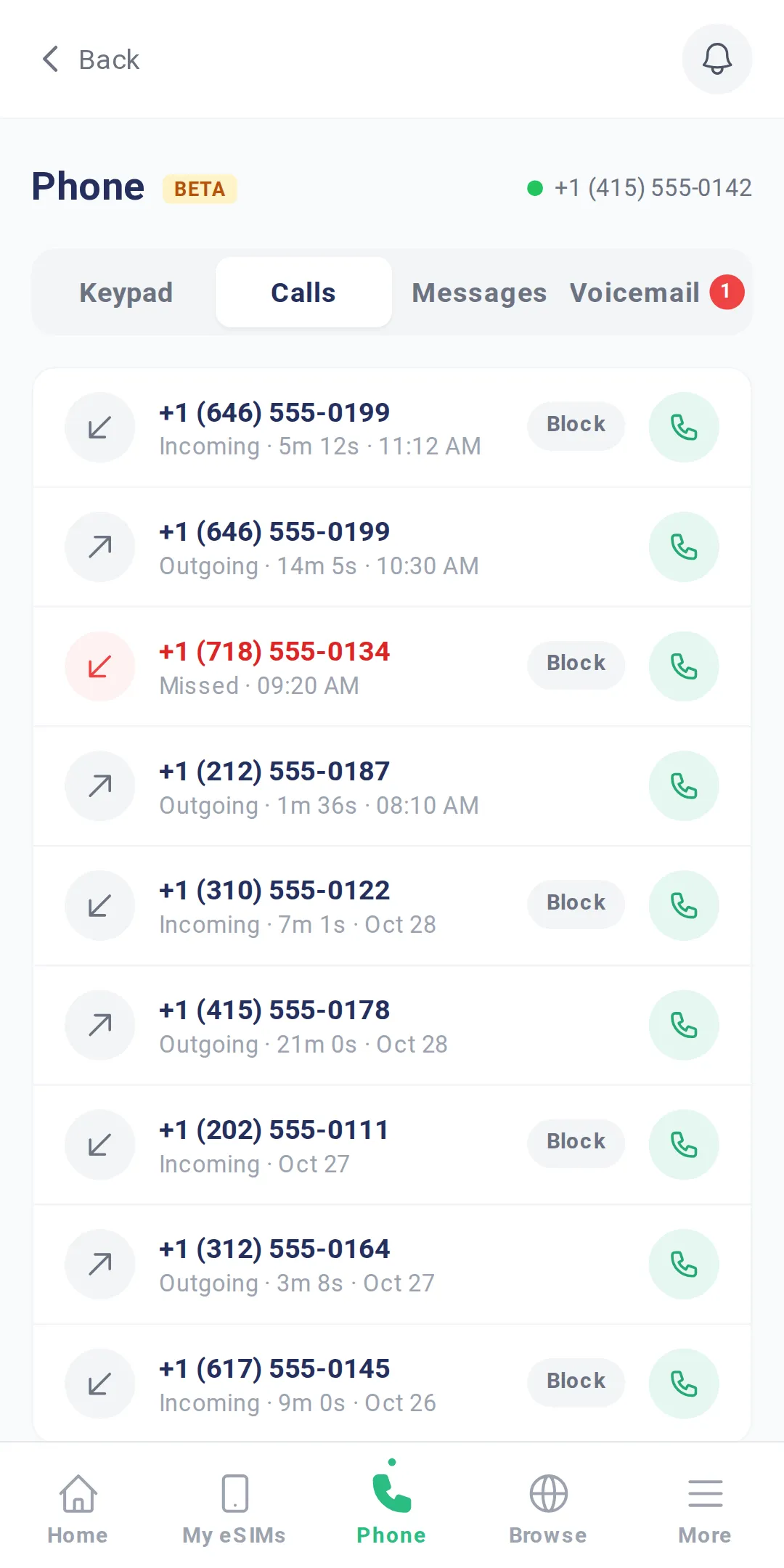
The TripoSIM US Virtual Number runs in the TripoSIM app over Wi-Fi or mobile data. On iPhone, add the TripoSIM web app to your Home Screen. On Android, install the TripoSIM app. You need an email address, a payment card and a short ID check with a photo ID and a selfie, about 2 minutes. You do not need a US address, an SSN or a US company.
Rules on internet calling differ by country, and on your network a call on the number is an internet call. Check with your regulator or mobile operator before you rely on calls, and keep your Brazilian number for calls inside Brazil.
Texts from US senders reach your number in the US and appear in the app over your connection. Verification codes from apps arrive the same way: Amazon, PayPal and Stripe sent codes to a TripoSIM number in TripoSIM’s tests on October 3, 2026. Register each account with your real country.
Which setup fits your work?
Developers and agencies. If you work as a contractor on a US team, stand-ups and reviews happen on video and use no minutes. The phone matters for the client’s product owner who calls from the car, or the new lead who found your agency and wants a quick word. With the hours this close, you can often answer live instead of calling back. For an agency, give each account manager their own number and app, or keep a separate number for each client brand, each with its own plan. The agencies page and how a US number helps you win US clients have more.
Creators. US brands and talent agencies sometimes want a short call before a deal. A +1 number in your media kit makes that an ordinary call for them, and voicemail catches the calls that come while you are filming. Instagram, TikTok and Google also sent codes in TripoSIM’s tests on October 3, 2026. See the creators page.
Online sellers. If you sell to US buyers, from your own store or a marketplace, a +1 support number on your site and packing slip lets buyers call about an order without making an international call. The online sellers page covers support lines and marketplace codes.
How do calls in and calls out add up?
Take Camila, a made-up example: she makes leather bags in Belo Horizonte and sells them to US buyers through her own online store. In a typical month, about 20 US customers call her about orders and sizes, for around 6 minutes each: 120 minutes. Those are calls to her, so they come from the separate fair use of 300 minutes a month and do not touch her outgoing minutes.
She calls out too: 10 call-backs to customers of about 5 minutes, and a weekly 20-minute call with her US shipping partner. That is roughly 50 plus 87, or about 137 minutes a month, inside the 300 minutes a month to the US and Canada. Each outgoing call is rounded up to the next full minute; unanswered calls are free.
In the US holiday season her call-backs double, to about 187 minutes out, and calls to her rise to about 240 minutes. Both still fit. Above the incoming fair use, callers reach voicemail until the next month, and extra outgoing minutes cost $5 per 100. The cost calculator works out your own month.
What should your contact page and voicemail say?
Because your hours match theirs, you can promise live hours, not just call-backs:
US support: +1 (your number). I answer Monday to Friday, 9 a.m. to 4 p.m. Eastern, from São Paulo, Brazil. Leave a voicemail outside those hours and I will call back the next US working day. For order questions in writing, email (your address).
Record the greeting in English. If you also sell to Portuguese speakers in the US, add one short sentence in Portuguese. Write “call or email”, not “call or text”, and give your real city: a US area code makes you easy to call, but it does not give you a US office. Voicemail messages can be up to 2 minutes, up to 30 a month, kept 30 days. The business contact checklist and the voicemail guide have more.
What can’t the number do?
- No sending texts. It receives texts only. For chat, US buyers can email you or use WhatsApp, which you can set up on the same US number. See WhatsApp Business with a US number.
- No calls out beyond the US and Canada. Use your Brazilian line for Brazilian numbers.
- No 911. It cannot call 911 or any emergency service, so keep your Brazilian number for emergencies.
- Not a team line. It is one person’s line for personal and small-business use, and call centers are not allowed.
The bottom line
From Brazil, US calls fit your normal day: New York from 10 or 11 a.m. São Paulo time, depending on the US season, and the West Coast after lunch. Put a +1 number on your site, proposals or media kit with your hours in Eastern time, answer live when you can, and let voicemail catch the rest. Check the rules on internet calling first, then test calls with the ten-check reliability test. The plans page has both plans: $100 a year or $12.99 a month.