A US number for independent truck dispatchers with US carriers
Brokers and drivers call a familiar +1 number about loads. You answer in an app, and call back in US hours.
Short answer
Independent truck dispatchers outside the US use a US virtual number so brokers, owner-operators and drivers can call a familiar +1 number about loads. The TripoSIM number rings in an app and includes 300 minutes a month of calls to the US and Canada, with extra minutes at $5 per 100. It is one dispatcher's line, and it cannot send texts.
Why give brokers and drivers a US number?
Dispatching runs on the phone. You call brokers about loads, agree rates, book the next pickup and check in with drivers, mostly in US business hours. Brokers and drivers save your number and call it back. A +1 number makes each of those calls an ordinary US call for the people you work with, and it sits easily next to their other US contacts.
The TripoSIM US Virtual Number runs in an app on your phone over Wi-Fi or mobile data, next to your local SIM. Calls ring like a normal call. When you are off shift, callers leave a voicemail. Be clear about where you are: "independent dispatcher based in [country], working US hours" is honest, and a +1 number does not give you a US office.
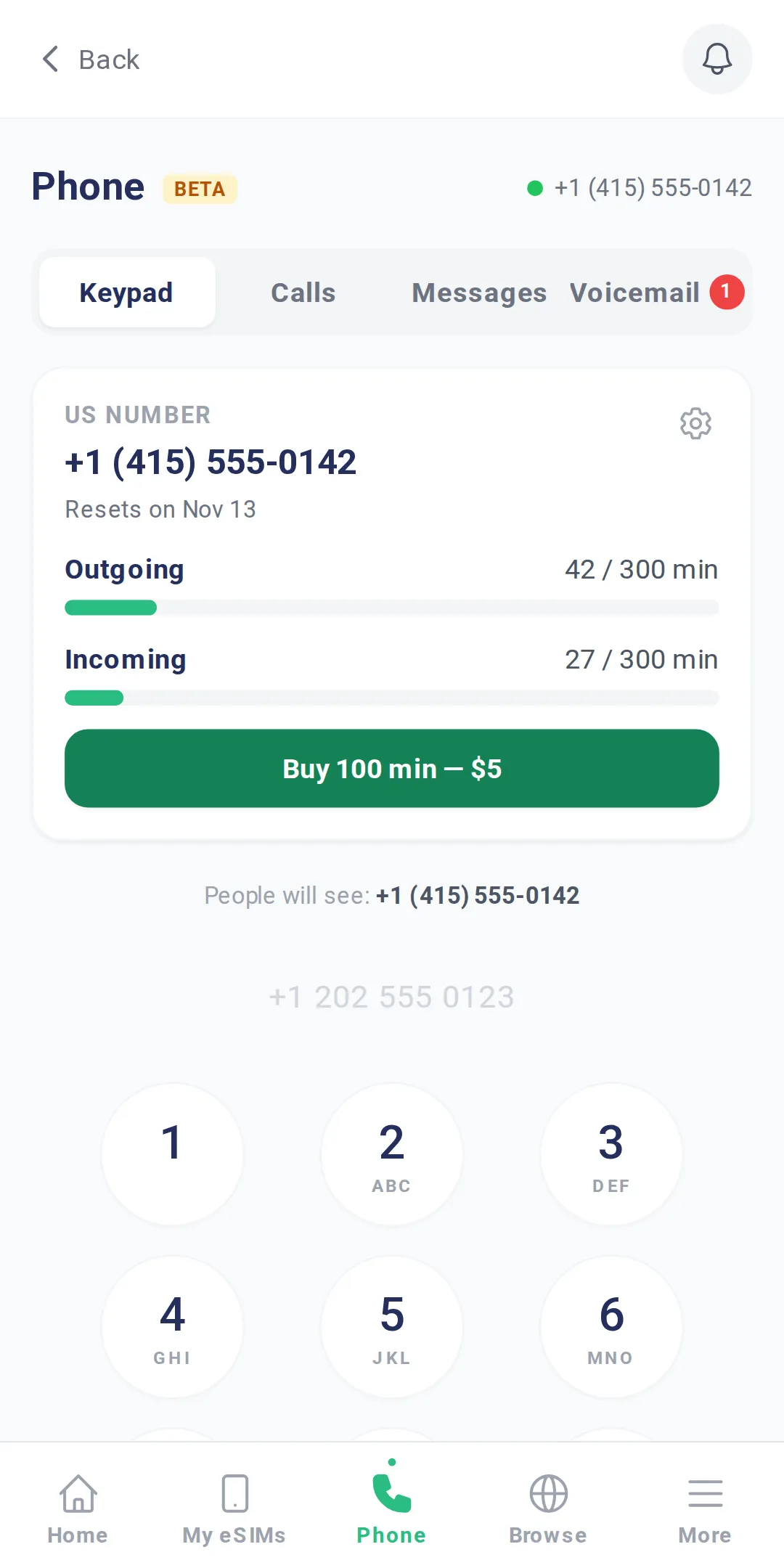
Minutes left this month, on the keypad. Real app screen, example number.
Who do you call, and who calls you?
A typical week for an independent dispatcher with a few small carriers. This is a made-up example, not a rule for every carrier:
Who a truck dispatcher talks to, and what works
Caller
Typical reason
What works
Freight broker
Typical reasonA load offer, a rate to agree or a check call on a load in transit
What worksAnswer live in US hours, then ask for the rate confirmation by email
Owner-operator you dispatch for
Typical reasonThe next load, a change of plan or a question about paperwork
What worksAgree a daily call time, and let voicemail take the rest
Driver for a small carrier
Typical reasonRunning late, a wrong address or a question at pickup
What worksAnswer live when you can; the greeting says how fast you call back
Shipper or receiver
Typical reasonAn appointment time or directions at the dock
What worksA short call from you, then a note to the driver
Confirm every rate and load you agree on a call by email, so the broker, the carrier and the driver all have it in writing.
Which hours do you cover?
Brokers mostly work US business hours, and many sit in Central time, an hour behind New York. Drivers start early and call at all hours. Many dispatchers abroad work a night shift to cover the US day. New York's 9 a.m. falls at about:
Philippines: 9 p.m. in the US summer, 10 p.m. in the US winter.
India: 6:30 p.m. in the US summer, 7:30 p.m. in the US winter.
Pakistan: 6 p.m. in the US summer, 7 p.m. in the US winter.
Romania or Bulgaria: 4 p.m. most of the year.
Los Angeles is three hours behind New York, so a West Coast load can keep you on the phone late. US clocks change on the second Sunday in March and the first Sunday in November, according to NIST, and countries that change on other dates, or not at all, move by an hour against the US. The best time to call US clients has more countries, and the US time-zone clock shows the time in each zone right now.
How many minutes does dispatching use?
Be honest with yourself here: dispatching is call-heavy. Only calls you place use your 300 minutes to the US and Canada. Each outgoing call is rounded up to the next full minute; unanswered calls are free. Three example dispatchers, worked out for a year:
300 min included
One owner-operatorabout 217 min, within the plan
A few small carriersabout 434 min: 17 extra packs, +$85 a year
A full book of trucksabout 867 min: 69 extra packs, +$345 a year
Within the included minutesExtra minutes, $5 per 100
Calls you place to brokers, drivers and docks, by how big your book is
Example
Calls out to the US and Canada
Extra minutes
One year on the yearly plan
One owner-operator
Calls out to the US and Canada10 calls a week, 5 minutes each: about 217 minutes a month
Extra minutesNone: within the included minutes
One year on the yearly plan$100
A few small carriers
Calls out to the US and Canada25 calls a week, 4 minutes each: about 434 minutes a month
Extra minutes17 × $5 = $85 a year
One year on the yearly plan$185
A full book of trucks
Calls out to the US and Canada40 calls a week, 5 minutes each: about 867 minutes a month
Extra minutes69 × $5 = $345 a year
One year on the yearly plan$445
Incoming calls do not use your minutes (fair use 300 minutes a month). Each plan includes 300 minutes a month out; extra minutes are $5 per 100, and unused extra minutes carry over to the next month, so the year counts the packs for all 12 months together. Prices before tax.
The first dispatcher fits inside the plan. The second goes over every month, so they need 17 extra packs of 100 minutes across a year. Top-up minutes carry over, so you can buy them as you go. The third uses about 2.9 times the included minutes. At that volume a business phone system built for outbound calling is the better tool. The monthly plan is $12.99 with the same minutes. Try your own numbers in the cost calculator.
Do calls from drivers and brokers count?
Calls to you do not use your outgoing minutes. They are included up to a fair use of 300 minutes a month, counted on their own. Dispatchers get many short calls in: if drivers and brokers call you 30 times a week for 3 minutes each, that is about 390 minutes a month, more than the fair use. After 300 incoming minutes in a month, callers reach voicemail until the next month.
On a busy book that matters as much as your own minutes. Agree set check-in times with drivers and call them yourself, so calls do not pile up on the incoming side.
What should your voicemail say?
Say who you dispatch for, your hours in US time and what to leave. For example:
"You have reached [your name], dispatch for [carrier or your business]. I work Monday to Friday, 7 a.m. to 5 p.m. Central. Leave your name, your company or truck number and the load number, and I will call you back. Rate confirmations and load details go to [your email]."
Messages can be up to 2 minutes, up to 30 a month, kept 30 days. A dispatcher can reach that monthly limit fast, so return calls through the day rather than letting messages stack up. The voicemail guide has setup steps.
Can several dispatchers share one number?
No. A dispatch office where several dispatchers answer or call from the same number is a call center, and call centers are not allowed. The number is for personal and small-business use: one dispatcher making and taking their own calls. If you hire a second dispatcher, they get their own number in their own app, with their own short ID check (photo ID and selfie).
Spam and robocalls are not allowed either, so do not connect the number to an autodialer.
Do you dispatch for more than one carrier?
The same person can have as many TripoSIM US numbers as they like on one account, each with its own plan, minutes and voicemail greeting. A dispatcher who works for two small carriers can give each its own number, so drivers hear the right name in the greeting and each carrier's calls stay in one place.
Each number is still one person's line. It does not ring several people at once or queue callers.
What about texts and load details?
The number receives texts from US and Canadian senders, so a broker's text with a load offer reaches the app. Sending texts is not included, so you cannot answer from the number. Brokers who text load details must email them to you instead: ask for load details and rate confirmations by email, and write "call or email" in your signature, not "call or text".
The number also receives verification codes (OTP SMS) from apps. TripoSIM tested Google, Microsoft, Payoneer and Wise, among others, so codes for your own email and payment accounts can come to it. Keep your number off the carriers' own accounts: codes for their accounts should reach them, not you.
When is another option better?
Someone needs to reach emergency services: the number has no 911 or emergency calling. Keep a local mobile line for that, and drivers use their own phones.
Several dispatchers work one line: call centers are not allowed. A business phone system built for teams suits a dispatch office.
You call well past 300 minutes every month: like the full book above, a plan built for outbound volume will fit better.
Brokers expect text replies from the number: the TripoSIM number receives texts only. A provider with two-way texting suits you better; see providers compared.
Your carriers or drivers are outside the US and Canada: calls out go to US and Canadian numbers only. Anyone can still call your number.
Get your US number
Two plans with the same number, minutes and app.
Best value, save 36%
Yearly plan
$100per year
About $8.33 a month, paid once a year
300 minutes a month to the US and Canada
Incoming calls, voicemail and texts from US senders
Prices in US dollars as published by TripoSIM. Payments are not refunded, except a full refund if your ID check fails or your number is not delivered within 72 hours, or where local law requires. Checkout continues on TripoSIM. Right after payment you complete an ID check with a selfie, then choose from the numbers available.