A US number for consultants and coaches with US clients
US clients book a call and dial a familiar +1 number. You answer in an app, from wherever you work.
Short answer
Consultants and coaches outside the US use a US virtual number so US clients can book and join calls on a familiar +1 number. The TripoSIM number rings in an app, takes voicemail when you are offline and includes 300 minutes a month of calls to the US and Canada. It receives texts but cannot send them.
Illustration. The phone screen is drawn, not the TripoSIM app.
Why give US clients a US number to call?
Most consulting and coaching work starts with a short call. A US prospect reads your site, books a discovery call and expects to dial a number or be called. If the number on the confirmation is international, some prospects will not dial it. They are unsure of the cost or the format. A +1 number removes that step.
The TripoSIM US Virtual Number runs in an app on your phone over Wi-Fi or mobile data. It keeps client calls apart from your personal number, and it works the same from Lisbon, Dubai or Manila. When you are asleep or with another client, callers leave a voicemail.
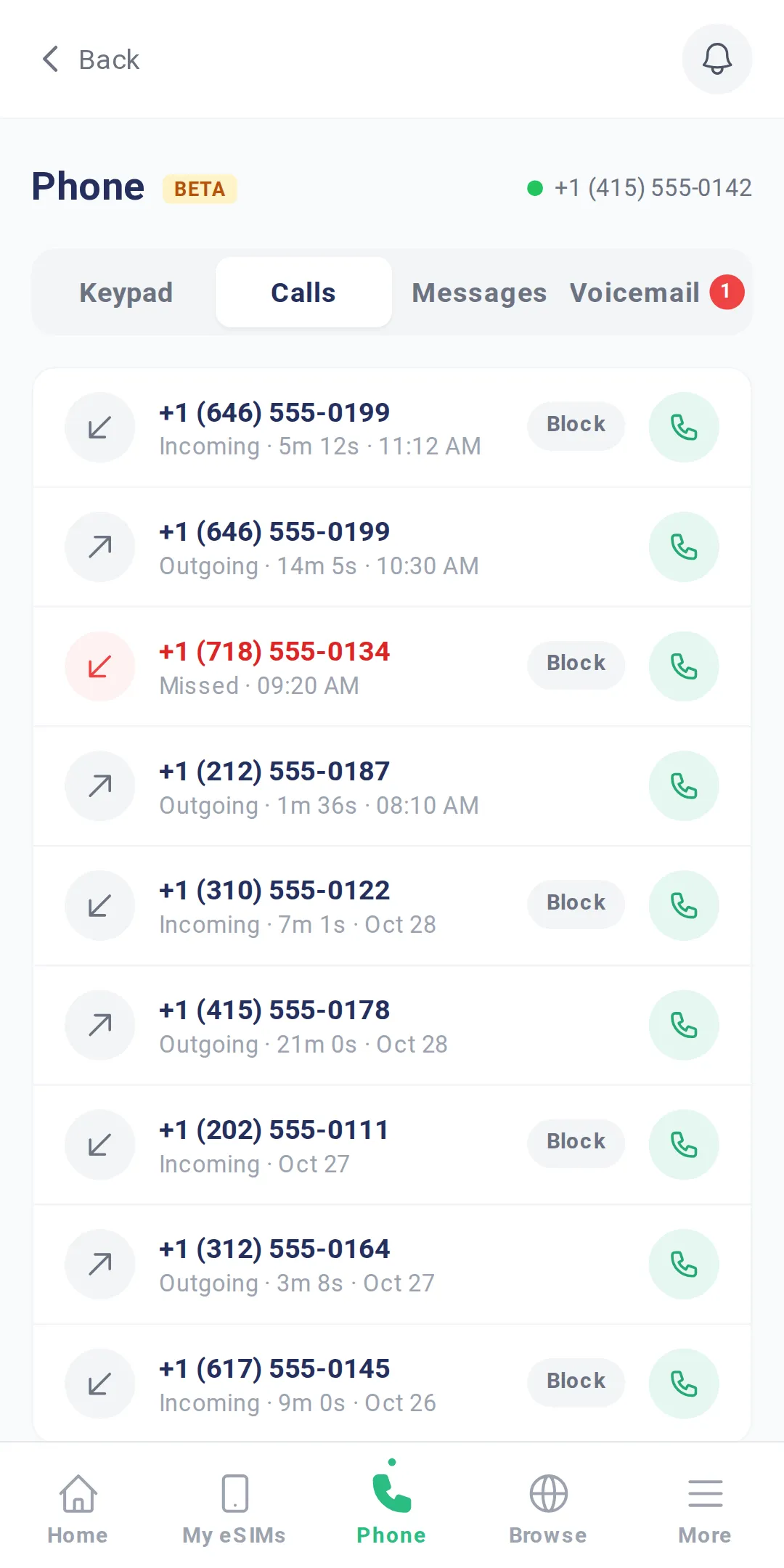
Client calls in and out, with times and lengths. Real app screen, example number.
How do booking links and phone calls fit together?
When a client books a phone call rather than a video call through your booking page, decide who dials. It changes which allowance you use.
The client dials you. Put your +1 number in the booking confirmation. Calls in are included up to a fair use of 300 minutes a month and do not touch your outgoing minutes.
You dial the client. Ask for their number on the booking form. Each call uses your 300 outgoing minutes to the US and Canada. Each outgoing call is rounded up to the next full minute; unanswered calls are free.
Either way, check that your booking page shows slots in the client's time zone, and add your own zone to the confirmation. "Tuesday 10 a.m. ET" is clear to everyone. "Tuesday 6 p.m." is not.
Which hours should you offer US clients?
Offer slots inside US business hours that are also sane for you. New York is UTC-5 in winter and UTC-4 in summer, and Los Angeles is three hours behind New York. Some windows that work, for East Coast clients:
UK: about 2 to 5 p.m. your time.
Central Europe: about 3 to 6 p.m.
UAE: about 5 to 8 p.m. in the US summer, 6 to 9 p.m. in the US winter.
India: about 6:30 to 9:30 p.m. in the US summer, an hour later in the US winter.
A prospect who reaches voicemail decides in a few seconds whether you are a real business. Say your name and practice, your hours in their time zone, and when you call back. For example:
"You have reached [your name] Coaching. I take calls Monday to Thursday, 10 a.m. to 2 p.m. Eastern. Leave your name, number and a good time to call, and I will call you back within one working day. You can also book a call from my website."
Messages can be up to 2 minutes, up to 30 a month, kept 30 days. With notifications and the microphone allowed, TripoSIM says calls ring even when the app is closed. The voicemail guide has setup steps.
Are the minutes enough for call-backs?
For discovery calls and call-backs, usually yes. Run most paid sessions on video and the numbers stay small. Three typical weeks of calls you place, worked out for a year:
300 min included
Discovery calls onlyabout 260 min, within the plan
Plus call-backsabout 390 min: 11 extra packs, +$55 a year
Weekly sessions by phoneabout 520 min: 27 extra packs, +$135 a year
Within the included minutesExtra minutes, $5 per 100
Calls you place to US clients, by how you work
Example
Calls out to the US and Canada
Extra minutes
One year on the yearly plan
Discovery calls only
Calls out to the US and Canada3 calls a week, 20 minutes each: about 260 minutes a month
Extra minutesNone: within the included minutes
One year on the yearly plan$100
Plus call-backs
Calls out to the US and Canadathe same, plus 3 call-backs a week of 10 minutes: about 390 minutes a month
Extra minutes11 × $5 = $55 a year
One year on the yearly plan$155
Weekly sessions by phone
Calls out to the US and Canada4 sessions a week, 30 minutes each: about 520 minutes a month
Extra minutes27 × $5 = $135 a year
One year on the yearly plan$235
Incoming calls do not use your minutes (fair use 300 minutes a month). Each plan includes 300 minutes a month out; extra minutes are $5 per 100, and unused extra minutes carry over to the next month, so the year counts the packs for all 12 months together. Prices before tax.
The monthly plan is $12.99 with the same minutes. If clients dial you instead, those minutes come from the incoming allowance. Count it separately; do not add the two together.
Calls clients make to you in a month, against the incoming fair use
Pattern
Calls from clients
Incoming minutes
Within fair use?
Clients dial you for discovery calls
Calls from clients8 calls of 20 minutes
Incoming minutes160
Within fair use?Yes
Clients also dial you for sessions
Calls from clientsthe same, plus 6 sessions of 45 minutes
Incoming minutes430
Within fair use?No: after 300 minutes, callers reach voicemail until the next month
The number receives texts from US and Canadian senders, but sending texts is not included. A client can text you "running five minutes late", and you will see it, but you cannot answer from the number. So:
Send reminders from your booking tool by email.
Write "call or email" on your site, not "call or text".
If a client texts, call them back or answer by email.
What does a week look like?
Take a coach in Dubai with US East Coast clients, in the US winter. Dubai is nine hours ahead of New York then.
Sunday: open booking slots for Tuesday to Thursday, 6 to 9 p.m. Dubai time, which is 9 a.m. to noon in New York.
Every morning: play voicemails left overnight and note who to call back.
Tuesday to Thursday evenings: one discovery call a day, plus call-backs to anyone who left a message.
Friday: check minutes used in the app against the month so far.
That is the "plus call-backs" row above. Do you keep two practices, for example coaching and consulting under different names? The same person can have more than one TripoSIM US number on one account, each with its own plan and greeting.
When is another option better?
Clients expect you to text back: the TripoSIM number receives texts only. A provider with two-way texting suits you better; see providers compared.
Most sessions happen by phone: at four phone sessions a week you already need extra minute packs, as the table shows. Run paid sessions on video and keep the number for discovery calls and call-backs.
An assistant or team shares the line: the number is for personal and small-business use, and call centers are not allowed. A business phone system built for teams fits better.
You call clients outside the US and Canada: calls out go to US and Canadian numbers only. Anyone can still call your number.
Get your US number
Two plans with the same number, minutes and app.
Best value, save 36%
Yearly plan
$100per year
About $8.33 a month, paid once a year
300 minutes a month to the US and Canada
Incoming calls, voicemail and texts from US senders
Prices in US dollars as published by TripoSIM. Payments are not refunded, except a full refund if your ID check fails or your number is not delivered within 72 hours, or where local law requires. Checkout continues on TripoSIM. Right after payment you complete an ID check with a selfie, then choose from the numbers available.