A US number for accountants and bookkeepers with US clients
US small businesses and Americans abroad call a familiar +1 number with their questions. You answer in an app, or call back in their hours.
Short answer
Accountants, bookkeepers and tax preparers outside the US use a US virtual number so US small businesses and Americans abroad can call a familiar +1 number. The TripoSIM number rings in an app, takes voicemail in your off-hours and includes 300 minutes a month of calls to the US and Canada. It receives texts but cannot send them.
Why give US clients a US number?
Most bookkeeping and accounting work runs through email, a client portal and the accounting software you share. The phone matters when something needs a conversation: a business owner who cannot tell what a payment was, a new client who wants to talk before signing up, or an American living abroad who has a letter in hand and wants to know what you need. For them, a +1 number is an ordinary call, and it is easier to put on your website, proposals and invoices than an international one.
The TripoSIM US Virtual Number runs in an app on your phone over Wi-Fi or mobile data, next to your local SIM. Client calls stay apart from your personal number. When you are in a file or off for the night, callers leave a voicemail. This page covers the phone setup only; it is not accounting or tax advice.
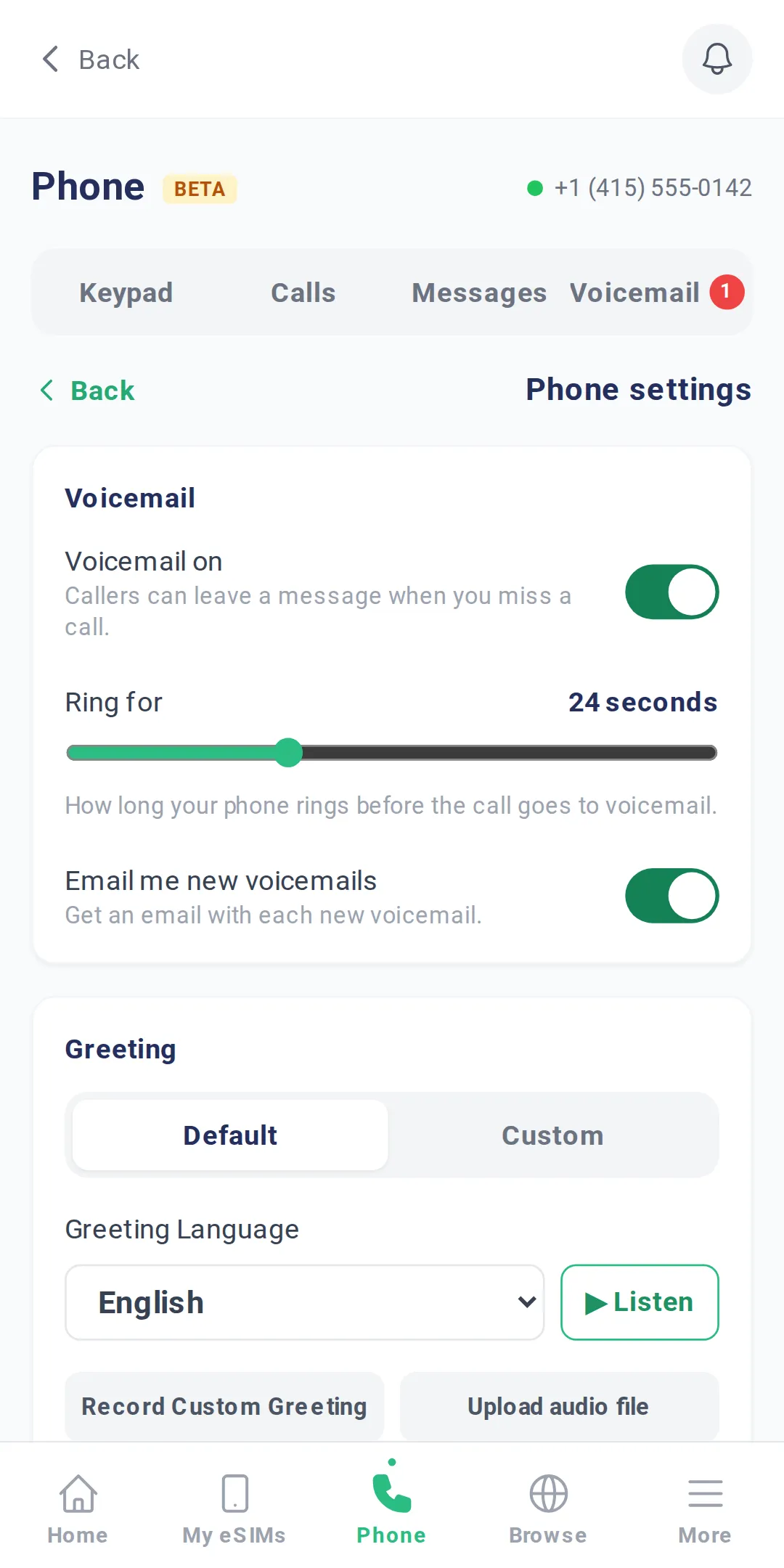
Voicemail alerts by email, useful in your busiest weeks. Real app screen, example number.
Who calls you, and what do they need?
A few kinds of callers in a typical month. This is an example, not a rule for every practice:
Who calls an accountant or bookkeeper with US clients, and what works
Caller
Typical reason
What works
Small business owner
Typical reasonA transaction they cannot place, a payroll date or a report they want explained
What worksAnswer in your call hours, then confirm what you agreed by email
New client
Typical reasonYour fees, what you cover and whether you work with their kind of business
What worksA short intro call, then the engagement terms in writing
American living abroad
Typical reasonA letter or form they received, and what you need from them
What worksAsk them to upload it to your portal first, then walk through it on a call
Client's office manager
Typical reasonMissing receipts, logins to an account or a deadline you set together
What worksA call-back, then a written list of what is still missing
Whatever you agree on a call, write it down in an email afterwards. A short "as discussed" note gives both of you a record, which a phone call does not.
Where should documents go, if not the phone?
Keep documents and account details off the phone line. Statements, receipts, ID copies and account numbers belong in the secure portal or the email setup your firm already uses, not in a text or a voicemail.
Voicemail: ask callers for their name, business and a good time to call, and nothing more. Say it in the greeting, so nobody reads out an account number.
Texts: the number receives texts from US and Canadian senders, but you cannot answer them from the number, and a text thread is a poor place to keep client papers. Write "call or email" on your site, not "call or text".
Calls: fine for questions and explanations. If a client starts to read out a card or account number, stop them and ask for the portal instead.
Follow your own firm's data policies first; these are habits that fit around them.
Which hours should you offer?
Many offshore bookkeepers already work part of the US day. If you do not, pick one or two short call windows inside US business hours and write them in Eastern time. New York's 9 a.m. falls at about:
Philippines: 9 p.m. in the US summer, 10 p.m. in the US winter.
India: 6:30 p.m. in the US summer, 7:30 p.m. in the US winter.
Pakistan: 6 p.m. in the US summer, 7 p.m. in the US winter.
Romania or Bulgaria: 4 p.m. most of the year.
Clients on the West Coast are three hours behind New York. US clocks change on the second Sunday in March and the first Sunday in November, according to NIST, and countries that change on other dates, or not at all, move by an hour against the US. The best time to call US clients has more countries, and the US time-zone clock shows the time in each zone right now.
What should your voicemail say?
Say your name and practice, your call hours in US time, what to leave and where documents go. For example:
"You have reached [your name], bookkeeping for US small businesses. I take calls Monday to Thursday, 9 to 11 a.m. Eastern. Leave your name, your business and a good time to call, and I will call you back within one working day. Please do not leave account numbers in this message. Documents go to the client portal or to [your email]."
Messages can be up to 2 minutes, up to 30 a month, kept 30 days. In your busiest weeks that monthly limit can matter, so point quick questions to email in the greeting and keep voicemail for call-back requests. The voicemail guide has setup steps.
Are the minutes enough in busy season?
Calls clients make to you are included up to a fair use of 300 minutes a month. Only calls you place use your 300 minutes to the US and Canada. Each outgoing call is rounded up to the next full minute; unanswered calls are free. For many practices with US clients, January to April is the busy stretch. Three example months, worked out as if every month looked the same:
300 min included
Quiet monthsabout 130 min, within the plan
Busy seasonabout 347 min: 6 extra packs, +$30 a year
Busy season plus reviewsabout 607 min: 37 extra packs, +$185 a year
Within the included minutesExtra minutes, $5 per 100
Calls you place to US clients, quiet months and busy season
Example
Calls out to the US and Canada
Extra minutes
One year on the yearly plan
Quiet months
Calls out to the US and Canada3 call-backs a week, 10 minutes each: about 130 minutes a month
Extra minutesNone: within the included minutes
One year on the yearly plan$100
Busy season
Calls out to the US and Canada8 call-backs a week, 10 minutes each: about 347 minutes a month
Extra minutes6 × $5 = $30 a year
One year on the yearly plan$130
Busy season plus reviews
Calls out to the US and Canadathe same, plus 2 review calls a week of 30 minutes: about 607 minutes a month
Extra minutes37 × $5 = $185 a year
One year on the yearly plan$285
Incoming calls do not use your minutes (fair use 300 minutes a month). Each plan includes 300 minutes a month out; extra minutes are $5 per 100, and unused extra minutes carry over to the next month, so the year counts the packs for all 12 months together. Prices before tax.
A busy season lasts a few months, not twelve. Say January to April look like the "busy season" row and the rest of the year like the "quiet months" row. Top-up minutes carry over, so you need 2 extra packs of 100 minutes for the whole season, and the year comes to $110 on the yearly plan. Move long review calls to a video meeting and the season stays much closer to the included minutes. The monthly plan is $12.99 with the same minutes. Try your own numbers in the cost calculator.
What about sign-in codes?
The number receives verification codes (OTP SMS) from apps. TripoSIM tested Google, Microsoft, PayPal, Wise, Payoneer and Stripe, among others, so codes for your own work accounts can come to it.
Keep your number off clients' own bank and payment accounts. Codes for their accounts should reach them, not you, and a code that arrives on your phone mixes your access with theirs. If you need access, use the user or accountant access the service offers.
One number per accountant, or one per brand?
The same person can have as many TripoSIM US numbers as they like on one account, each with its own plan, minutes and voicemail greeting. A bookkeeper who also runs a separate practice for Americans abroad can give each its own number and greeting, so the caller hears the right name. In a small firm, each accountant can have their own number in their own app, and clients always reach the person who knows their file.
Each number is still one person's line. It does not ring several people at once or queue callers.
When is another option better?
Clients expect text replies from the number: the TripoSIM number receives texts only. A provider with two-way texting suits you better; see providers compared.
A front desk answers for the whole firm: the number is for personal and small-business use, and call centers are not allowed. Call queues and shared lines need a business phone system built for teams.
Your clients are mostly outside the US and Canada: calls out go to US and Canadian numbers only. Anyone can still call your number.
Your connection is weak in the evenings you call: calls need Wi-Fi or mobile data. Run the ten-check test first.
Get your US number
Two plans with the same number, minutes and app.
Best value, save 36%
Yearly plan
$100per year
About $8.33 a month, paid once a year
300 minutes a month to the US and Canada
Incoming calls, voicemail and texts from US senders
Prices in US dollars as published by TripoSIM. Payments are not refunded, except a full refund if your ID check fails or your number is not delivered within 72 hours, or where local law requires. Checkout continues on TripoSIM. Right after payment you complete an ID check with a selfie, then choose from the numbers available.