

If you run a business from outside the US, your voicemail greeting does a lot of work. Many US callers will reach it, because their working day is your evening or night. These scripts are ready to adapt: swap in your name, hours and email, then record.
What should every greeting include?
Four things, in this order:
- Who they reached. Your name or business name, so the caller knows they dialed the right number.
- When you answer. Days and hours, with a US time zone.
- What to leave. Name, number and the reason for the call, plus anything you need, like an order number.
- When you call back. “Within one working day” or “the same day”. Then keep that promise.
Keep it under 30 seconds, and speak a little slower than you normally would.
How do you write hours in a US time zone?
Say “Eastern”, “Central”, “Mountain” or “Pacific”, not “EST” or “PST”. EST is Eastern Standard Time, which New York uses only from early November to mid-March. The rest of the year it is on Eastern Daylight Time, according to NIST. “Eastern” is right all year.
Pick the zone where most of your callers are. If you work from Manila and answer from 9 p.m. to 1 a.m. your time, that is 8 a.m. to noon Eastern in the US winter and 9 a.m. to 1 p.m. Eastern in the US summer. Pick hours that work in both seasons, or re-record when the clocks change. The best time to call US clients has the windows for other countries, and the US time-zone clock shows each zone now.
Which scripts can you use?
1. Freelancer
“Hi, you’ve reached [your name], [web designer]. I take calls Monday to Thursday, 9 a.m. to 1 p.m. Eastern. Leave your name, number and what your project is about, and I’ll call you back within one working day. You can also email me at [email].”
2. Consultant or coach
“You’ve reached [your name] at [practice name]. I’m with a client or away from my desk. I return calls Tuesday to Thursday, 10 a.m. to 2 p.m. Eastern. Leave your name and number, or book a discovery call on my website at [website]. Talk soon.”
3. Agency
“Thanks for calling [agency name]. You’ve reached [your name], account manager. Our US hours are Monday to Friday, 9 a.m. to noon Eastern. If you’re a client, leave your name and project, and I’ll call you back today or first thing tomorrow. For anything urgent on a live project, email [email] and our team will see it.”
4. Online store support
“Thanks for calling [store name] customer support. We answer Monday to Friday, 9 a.m. to 1 p.m. Eastern. Leave your name, your order number and the best number to reach you, and we’ll call you back within one working day. For returns, see the returns page on our website.”
5. Tutor or teacher
“Hi, you’ve reached [your name], [math] tutor. I’m probably teaching right now. I return calls Monday to Friday between 8 and 10 a.m. Eastern. Please leave your name, your child’s first name and a good time to call. For lesson changes, email works best: [email].”
6. Translator or virtual assistant
“You’ve reached [your name], [Spanish to English] translator. I work US hours Monday to Friday, 8 a.m. to noon Pacific. Leave your name, number and deadline, and I’ll call you back the same working day. To send files, please email [email].”
7. Software or app founder
“Thanks for calling [product name]. You’ve reached [your name]. For support, the fastest way is email at [support email]. For sales or partnerships, leave your name, company and number, and I’ll call you back within one working day. Our hours are Monday to Friday, 10 a.m. to 2 p.m. Eastern.”
8. Vacation rental host
“Hi, you’ve reached [your name], host at [property name]. Leave your name, your booking dates and your question, and I’ll call you back as soon as I can. Check-in details are in your booking messages.”
If you host on a platform, keep bookings and payments on that platform. See the Airbnb guide for setup.
9. Out of office or holiday
“You’ve reached [business name]. We’re away from [date] to [date] and back on [date]. Messages left now will be returned when we’re back. For anything urgent before then, email [email].”
10. After hours
“You’ve reached [business name] outside our hours. We answer Monday to Friday, 9 a.m. to 5 p.m. Central. Leave your name and number after the tone, and we’ll call you back next business day.”
What should you leave out?
- “Call or text.” Texts reach you, but the TripoSIM number cannot send texts. Say “call or email”.
- A menu. Do not say “press 1 for sales” unless you have a phone system with a menu.
- “Available 24/7”. Only say it if someone really answers at all hours.
- A US office you do not have. Say your hours, not a street address.
- A promise you cannot keep. If you call back within two days, do not say “within the hour”.
- Personal details. Never ask callers to leave card numbers or passwords in a message.
How do you record and test it?
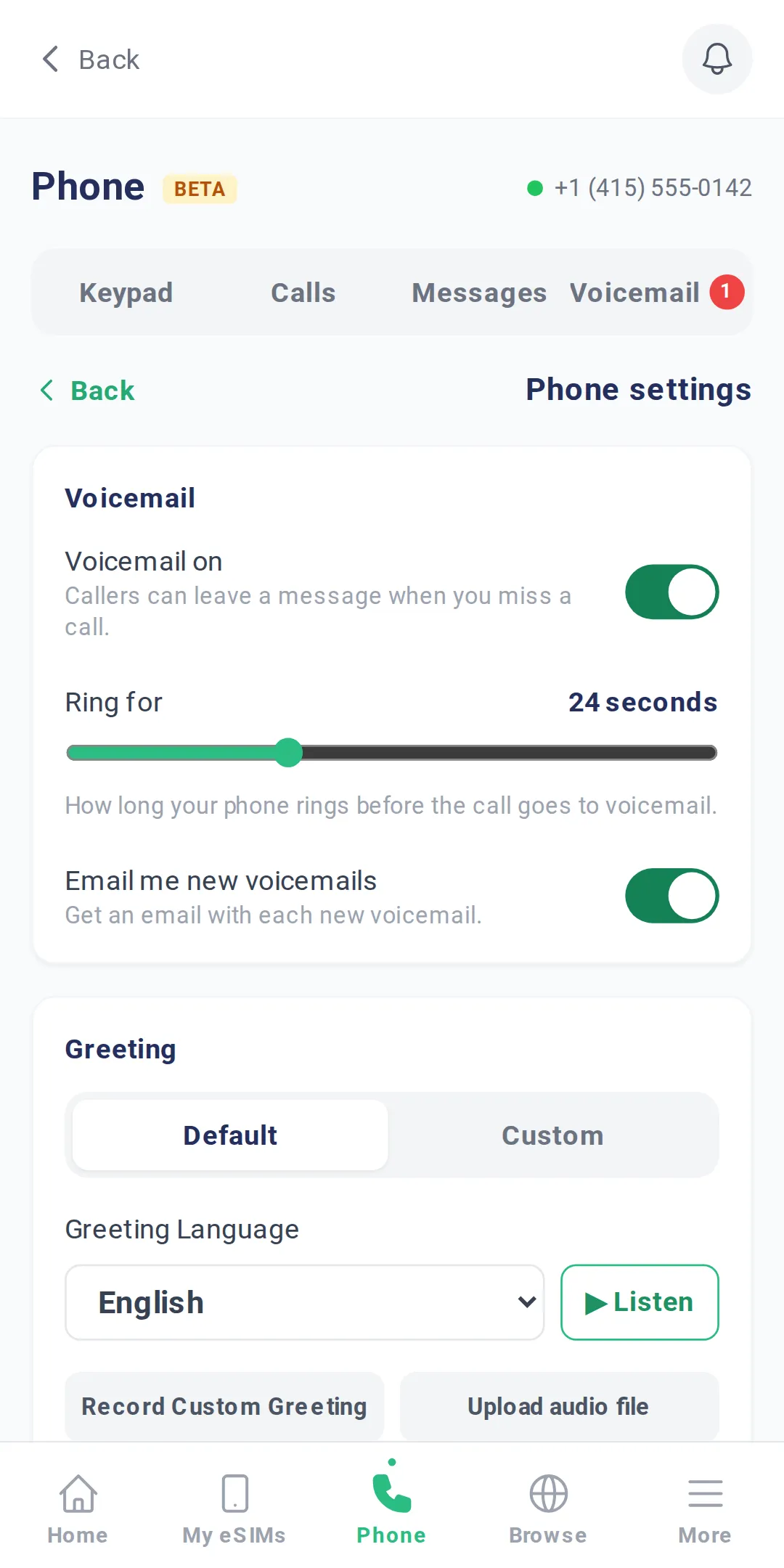
In the TripoSIM app, the phone settings include greeting options, the ring time and email alerts for new voicemails. Record in a quiet room, play it back once, and re-record if you rushed.
Then test it like a caller would:
- Ask a friend to call while the app is closed and you do not answer. TripoSIM says calls ring even when the app is closed once notifications and the microphone are allowed; a phone that is off, offline or has notifications blocked does not ring, and callers reach voicemail.
- Check the greeting plays in full and the message arrives.
- Play the message and check you get the email alert.
Messages can be up to 2 minutes, up to 30 a month, kept 30 days. Incoming calls are included with a fair use of 300 minutes a month. Above that, callers go straight to voicemail until the next month. If you expect dozens of calls a day, a business phone system fits better. The voicemail guide covers alerts and missed calls in more detail.
Bottom line
A good greeting is short and specific: who you are, when you answer in a US time zone, what to leave and when you call back. Pick the script closest to your business, swap in your details, record it, and test it once from another phone. Then list the same hours on your contact page so the greeting and the page say the same thing.