

Thailand draws three very different groups with ties to the US: remote workers in Chiang Mai’s cafés and coworking spaces, American retirees in Hua Hin, Chiang Mai and Pattaya, and hotels and dive shops on the islands whose guests fly in from the US. All of them live with a gap of 11 to 15 hours, depending on the US zone and the season. Here is how the hours line up, when each group should call, and how a +1 number fits.
When do Thai and US hours overlap?
Thailand is UTC+7 all year and does not change its clocks (IANA tz database). US Eastern time is UTC-5 in winter and UTC-4 in summer, Central is an hour behind Eastern and Pacific three hours behind, and US summer runs from the second Sunday in March to the first Sunday in November (NIST).
Here is a US working day, 9 a.m. to 5 p.m., in Thailand time:
| Your contact is in | US summer, Thailand time | US winter, Thailand time |
|---|---|---|
| Eastern (New York, Washington, Miami) | 8 p.m. to 4 a.m. | 9 p.m. to 5 a.m. |
| Central (Chicago, Dallas, Houston) | 9 p.m. to 5 a.m. | 10 p.m. to 6 a.m. |
| Pacific (Los Angeles, San Francisco, Seattle) | 11 p.m. to 7 a.m. | Midnight to 8 a.m. |
For work, the window is your evening: about 8 to 11 p.m. Thai time covers New York’s morning in the US summer, and 9 p.m. to midnight in the US winter. The West Coast day starts at 11 p.m. or midnight your time, and its afternoon is your early morning: 4 to 5 p.m. Pacific is 6 to 7 a.m. in Thailand in the US summer and 7 to 8 a.m. in the US winter.
For family, the easy window is your morning. From 7 to 9 a.m. in Thailand it is 8 to 10 p.m. the evening before in New York in the US summer, and 7 to 9 p.m. in the US winter; in California it is late afternoon. So a Sunday-morning call from Chiang Mai catches your children on Saturday evening. US clocks go back on November 1, 2026 and forward on March 14, 2027, and each time these windows move by an hour. The US time-zone clock shows each zone right now.
How does a US number work from Thailand?
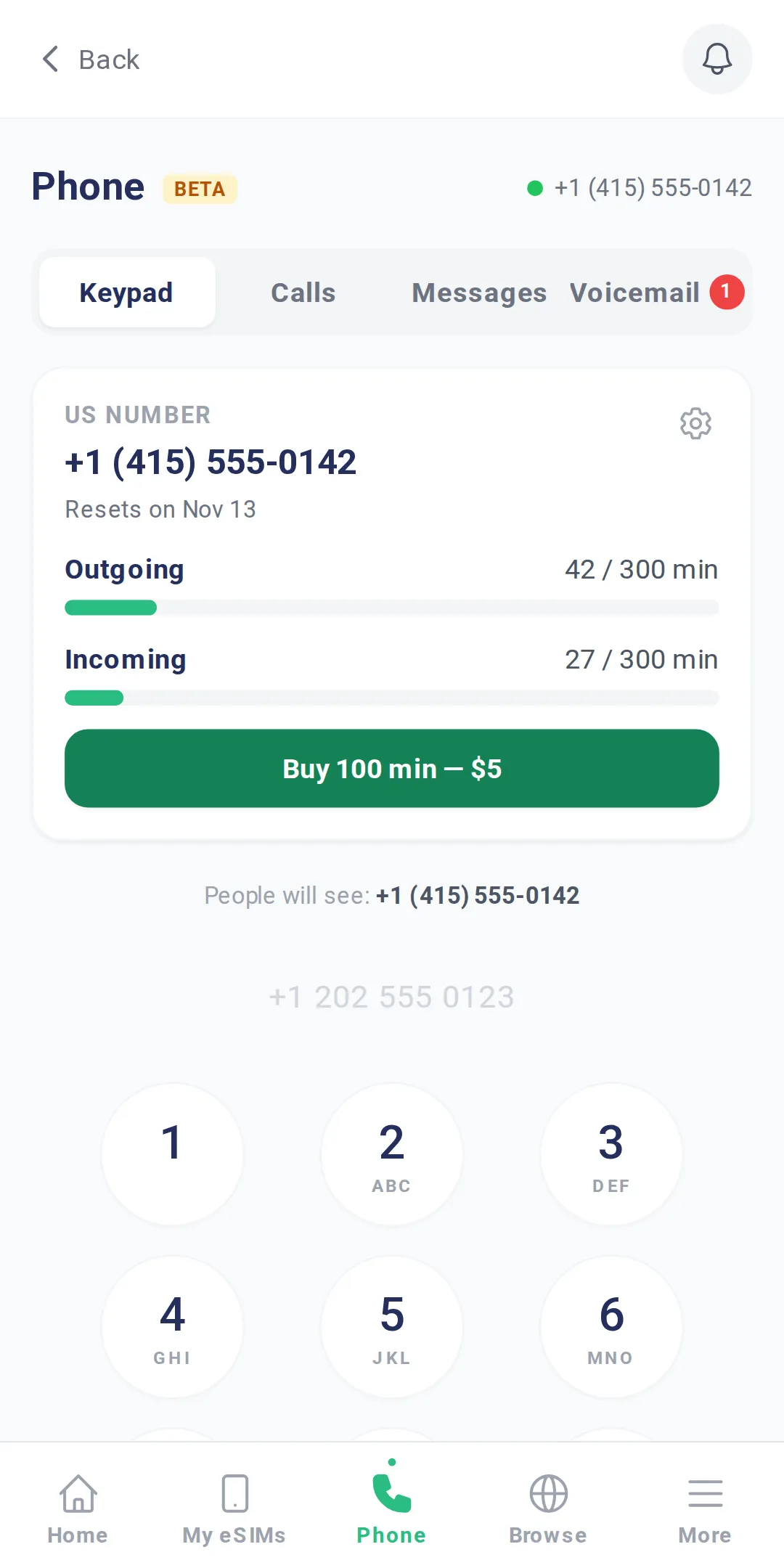
The TripoSIM US Virtual Number runs in the TripoSIM app over Wi-Fi or mobile data, on the same phone as your Thai SIM. On iPhone, add the TripoSIM web app to your Home Screen. On Android, install the TripoSIM app. You need an email address, a payment card and a short ID check with a photo ID and a selfie, about 2 minutes. You do not need a US address or an SSN.
Before you rely on it, one check matters. Rules on internet calling differ by country, and a call on the number is an internet call on your network. Check with your regulator or mobile operator, and keep your Thai number for calls inside Thailand. Thai friends, landlords and shops will mostly reach you on LINE or your Thai number; the +1 number is for the people back in the US.
Texts from US senders reach your number in the US and appear in the app over your connection, and verification codes from apps arrive the same way.
Which setup fits you?
Digital nomads in Chiang Mai. A Thai SIM or a travel eSIM gives you data, and the app gives you a US number that stays the same when you move on to the next country. Working full US Eastern hours from Chiang Mai means working nights, so many people agree a partial overlap instead: 8 to 11 p.m. Thai time for calls, with the rest of the day for focused work. The digital nomads page and the nomad phone setup walk through it.
US retirees. Children and grandchildren, a doctor’s office or pharmacy you still use, and banks and insurers with only a +1 number on file can keep calling you as before. You answer on your own phone in Hua Hin or Pattaya. A word on scam calls: do not read a verification code or a card number to anyone who called you; hang up and call back on a number you look up yourself. The retirees page covers setting it up step by step.
Hotels, dive shops and tour operators. American guests often want to talk before they book: which course suits a beginner, how the ferry and transfers work, what to bring. A +1 number on your website makes that an ordinary US call. Their evening calls reach you around breakfast, which is a good time to answer live, and the rest go to voicemail. On an island, keep mobile data on as a backup to Wi-Fi. The tour operators page covers inquiry lines and busy seasons.
How many minutes does a typical month use?
Take Carol, a made-up example: a retired teacher from Ohio who lives in Hua Hin. Her daughter in Columbus calls her every Saturday evening, which is Sunday morning in Hua Hin, for about 45 minutes. That is about 195 minutes a month, and it does not use Carol’s minutes: calls to her come from a separate fair use of 300 minutes a month.
Carol calls her son in San Diego every Wednesday morning, which is Tuesday early evening for him, for about 30 minutes: about 130 minutes a month. She also calls her pharmacy and her doctor’s office in Ohio about four times a month, 8 minutes each, after dinner at 9 p.m. her time, which is 10 a.m. in Ohio in the US summer and 9 a.m. in the US winter. That brings her to about 162 minutes, well inside the 300 minutes a month to the US and Canada. Each outgoing call is rounded up to the next full minute; unanswered calls are free. So when her son does not pick up, the call costs her no minutes. The cost calculator works out your own month.
What should your voicemail say?
For family and offices back home, say where you are and when you call back, in their time:
Hi, this is Carol. I live in Thailand now, 11 or 12 hours ahead of Ohio. Leave your name and number and I will call you back in your evening or your next morning.
For a hotel or dive shop, give your business name, your real town and your call-back hours in Eastern or Pacific time, and write “call or email”, not “call or text”. A US area code makes you easy to call; it does not give you a US office. Voicemail messages can be up to 2 minutes, up to 30 a month, kept 30 days. The voicemail guide has more.
What can’t the number do?
- No sending texts. It receives texts only. For written messages, use email or WhatsApp, which you can set up on the same US number.
- No calls out beyond the US and Canada. Use your Thai line for Thai numbers.
- No 911. It cannot call 911 or any emergency service, so keep your Thai number for emergencies.
- No internet, no ring. If your connection drops, callers reach voicemail. Give contacts email as the backup.
The bottom line
From Thailand, work calls to the US fit your evening, from about 8 p.m. in the US summer or 9 p.m. in the US winter, and family calls fit your morning, when the US is in its evening of the day before. Give the people back home a +1 number, put your hours in their time zone, and let voicemail and free unanswered calls cover the rest. Check the rules on internet calling first, then test calls with the ten-check reliability test. For other countries, see US phone numbers by country. The plans page has both plans: $100 a year or $12.99 a month.