

Americans retire to the Algarve and Cascais, take remote jobs from Lisbon and Porto, and spend a season working from Madeira. Wherever you settle, the US side of your life keeps calling: children and grandchildren, a doctor’s office, an accountant, an employer or a client. Here is when those calls arrive on your clock, the weeks each year the gap shifts, how a +1 number fits each way of living in Portugal, and what to check first.
When do Portuguese and US hours overlap?
Mainland Portugal and Madeira are on UTC+0 in winter and UTC+1 in summer, the same clock as London. The Azores are on UTC-1 in winter and UTC+0 in summer, an hour behind Lisbon all year. All of Portugal changes its clocks on the last Sunday in March and the last Sunday in October (IANA tz database). US Eastern time is UTC-5 in winter and UTC-4 in summer, Central is an hour behind Eastern and Pacific three hours behind, and US summer runs from the second Sunday in March to the first Sunday in November (NIST).
Here is a US working day, 9 a.m. to 5 p.m., in Portugal for most of the year:
| A US working day in | Lisbon and Madeira time | Azores time |
|---|---|---|
| Eastern (New York, Boston, Miami) | 2 p.m. to 10 p.m. | 1 p.m. to 9 p.m. |
| Central (Chicago, Dallas, Houston) | 3 p.m. to 11 p.m. | 2 p.m. to 10 p.m. |
| Pacific (Los Angeles, San Francisco, Seattle) | 5 p.m. to 1 a.m. | 4 p.m. to midnight |
For retirees, what matters is when people call. A doctor’s office or pharmacy calling at 3 p.m. Eastern reaches you at 8 p.m. in Lisbon. A son in Seattle calling after work, at 6 p.m. Pacific, reaches you at 2 a.m. For remote workers on US teams, a 10 a.m. stand-up in New York is 3 p.m. your time, and a 10 a.m. one in San Francisco is 6 p.m.
Which weeks does the gap shrink?
The US and Portugal both use summer time, but they switch on different Sundays: the US on the second Sunday in March and the first Sunday in November, Portugal on the last Sunday in March and the last Sunday in October. In the weeks between, every US time arrives an hour earlier on your clock. Here is the year ahead:
| Dates | What is happening | New York’s 9 a.m. in Lisbon and Madeira | New York’s 9 a.m. in the Azores |
|---|---|---|---|
| November 1, 2026 to March 13, 2027 | Both on winter time | 2 p.m. | 1 p.m. |
| March 14 to 27, 2027 | US on summer time, Portugal not yet | 1 p.m. | noon |
| March 28 to October 30, 2027 | Both on summer time | 2 p.m. | 1 p.m. |
| October 31 to November 6, 2027 | Portugal back on winter time, US not yet | 1 p.m. | noon |
| From November 7, 2027 | Both on winter time | 2 p.m. | 1 p.m. |
This autumn’s short week has just ended: Portugal’s clocks went back on October 25, 2026 and US clocks went back on November 1, 2026, so Lisbon is five hours ahead of New York again until March 14, 2027.
For family calls, the change catches people out. If you ring your daughter in Boston every Sunday at 7 p.m. Lisbon time, she normally picks up at 2 p.m.; in the mismatch weeks it is 3 p.m. her time. If she sets the call for 2 p.m. her time, it reaches you at 6 p.m. instead of 7. For remote workers, a US team’s 9 a.m. stand-up moves from 2 p.m. to 1 p.m. on your calendar. Agree whose clock a regular call follows, and look at the week ahead after each change.
How does a US number work from Portugal?
The TripoSIM US Virtual Number runs in the TripoSIM app over Wi-Fi or mobile data, on the same phone as your Portuguese line. On iPhone, add the TripoSIM web app to your Home Screen. On Android, install the TripoSIM app. You need an email address, a payment card and a short ID check with a photo ID and a selfie, about 2 minutes. You do not need a US address or an SSN.
Rules on internet calling differ by country, and on your network a call on the number is an internet call. Check with your regulator or mobile operator before you rely on calls, and keep your Portuguese number for calls inside Portugal.
Texts from US senders reach your number in the US and appear in the app over your connection, and verification codes from apps arrive the same way. Apple ID, Google, PayPal and Wise sent codes to a TripoSIM number in TripoSIM’s tests on October 3, 2026.
Which setup fits how you live?
US retirees. Pick an area code your family knows, such as the one where your children live, so the number is easy for them to save. A son or granddaughter can help with setup during a visit or on a video call. Then family, a doctor’s office, a pharmacy confirming a refill and your accountant can keep calling a +1 number, and voicemail catches the calls that come while you are out or asleep. The retirees page walks through it step by step.
Expats and remote workers. If you moved to Lisbon or Porto with a US employer or US clients, a +1 number keeps HR, payroll questions and client calls on a US number, separate from your Portuguese line. If you are still deciding what to do with your old US number, read keep your US number or get a new one? and the expats page.
Digital nomads. A season in Madeira, then somewhere else: the app number does not depend on the SIM in your phone, so it stays the same when you move on. Use a Portuguese SIM or eSIM for data while you are here. The digital nomads page and the digital nomad phone setup explain the two layers.
How many minutes does a retired couple use?
Take Carol and Jim, a made-up example: a retired couple from Virginia living in Tavira, in the Algarve. Each has their own US number in the app, with their own plan and ID check.
Carol calls her daughter in Richmond three times a week for 20 minutes, about 260 minutes a month. On weekends, her grandchildren call her, about four calls of 30 minutes a month. Those are calls to her, so they come from the separate fair use of 300 minutes a month and do not use her outgoing minutes. Carol stays inside the 300 minutes a month to the US and Canada. Each outgoing call is rounded up to the next full minute; unanswered calls are free.
Jim makes fewer, longer calls: about 90 minutes a month with their accountant and the property manager for the house they rent out in Virginia, and more in the weeks before a tax deadline. If one of them runs over, extra minutes cost $5 per 100. The cost calculator works out your own month.
What should your voicemail say?
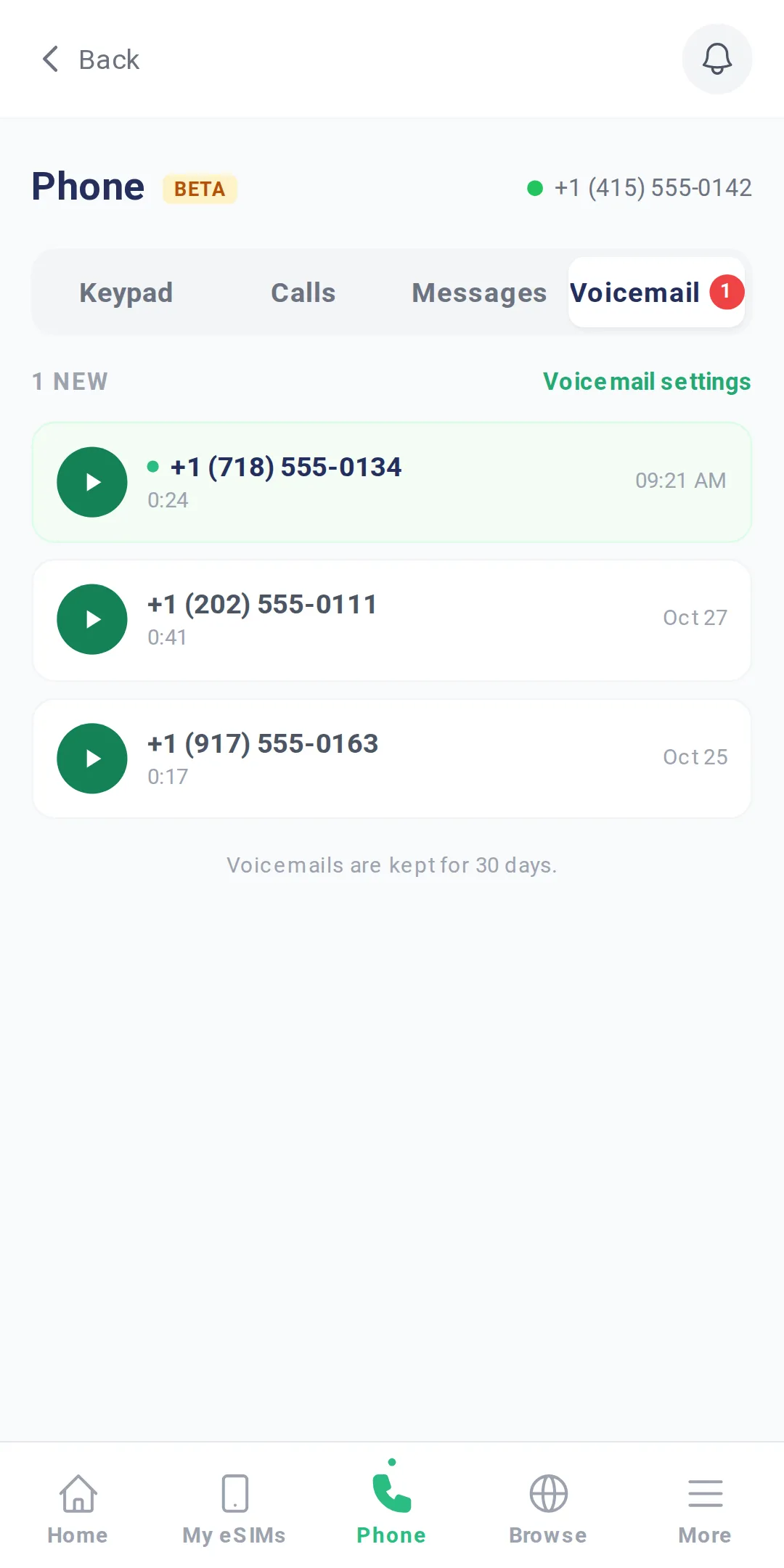
For family and offices, a short greeting with your name and when you call back is enough:
Hi, you’ve reached Carol. I live in Portugal now, so I may be asleep when you call. Leave a message and I’ll call you back between 9 a.m. and noon Eastern.
Giving the call-back time in Eastern keeps it right for your callers all year; in the mismatch weeks, it is your own afternoon that moves. For work, add your hours and email address, and write “call or email”, not “call or text”. Voicemail messages can be up to 2 minutes, up to 30 a month, kept 30 days. The voicemail guide has more greetings.
What can’t the number do?
- No sending texts. It receives texts only. Family can call, email or use WhatsApp, which you can set up on the same US number.
- No calls out beyond the US and Canada. Use your Portuguese line for Portuguese numbers.
- No 911. It cannot call 911 or any emergency service, so keep your Portuguese number for emergencies.
- No internet, no ring. If your Wi-Fi or data drops, callers reach voicemail.
The bottom line
From Portugal, US calls arrive in your afternoon and evening: New York from 2 p.m. in Lisbon and Madeira for most of the year, 1 p.m. in the mismatch weeks, and an hour earlier again in the Azores. In 2027 those weeks are March 14 to 27 and October 31 to November 6, so check regular family calls and stand-ups then. Give family, offices and clients a +1 number, put your call-back time in Eastern, and let voicemail take the calls that come in your night. Check the rules on internet calling first, then test calls with the ten-check reliability test. For other countries, see US phone numbers by country. The plans page has both plans: $100 a year or $12.99 a month.