

If you are a virtual assistant in Manila, Cebu or Davao working for a US small business, your day starts when your client’s does, which is usually your evening. Much of the work ends in a phone call: a supplier, a delivery company, a customer with a booking. Here is how the time zones line up, a night-shift routine that keeps calls in their place, and how a US number fits in.
When does a Manila workday overlap with US hours?
The Philippines is UTC+8 all year and does not change its clocks (ITU). US Eastern time is UTC-5 in winter and UTC-4 in summer, and US summer runs from the second Sunday in March to the first Sunday in November (NIST). So the gap to New York is 12 hours in the US summer and 13 hours in the US winter.
Here is a US working day, 9 a.m. to 5 p.m., in Manila time:
| Your client is in | US summer, Manila time | US winter, Manila time |
|---|---|---|
| Eastern (New York, Atlanta, Miami) | 9 p.m. to 5 a.m. | 10 p.m. to 6 a.m. |
| Central (Chicago, Dallas, Houston) | 10 p.m. to 6 a.m. | 11 p.m. to 7 a.m. |
| Pacific (Los Angeles, Seattle) | Midnight to 8 a.m. | 1 a.m. to 9 a.m. |
Two things catch people out. First, the US day ends on your next calendar day, so a US Friday ends on your Saturday morning, and your Monday evening is the start of the US Monday. Second, for West Coast clients your shift starts after midnight. The US time-zone clock shows each zone right now.
What changes when US clocks go back?
On November 1, 2026, US clocks go back an hour. Manila’s do not. From that week, the same New York workday arrives an hour later for you: 10 p.m. to 6 a.m. instead of 9 p.m. to 5 a.m. On March 14, 2027, it moves back again.
Agree with each client before the change which of these you want:
- Your shift follows US time. You keep covering 9 to 5 Eastern, and your hours in Manila move an hour later each November.
- Your shift follows Manila time. You keep 9 p.m. to 5 a.m., which covers 8 a.m. to 4 p.m. Eastern in the winter.
Either works. What matters is that your calendar invites, your email signature and your voicemail greeting all say the same thing. Write hours as “Eastern”, not “EST”, so they stay right all year.
What does a night-shift routine look like?
Take Joy, a made-up example: a VA in Quezon City working for a small property company in New York, in the US summer.
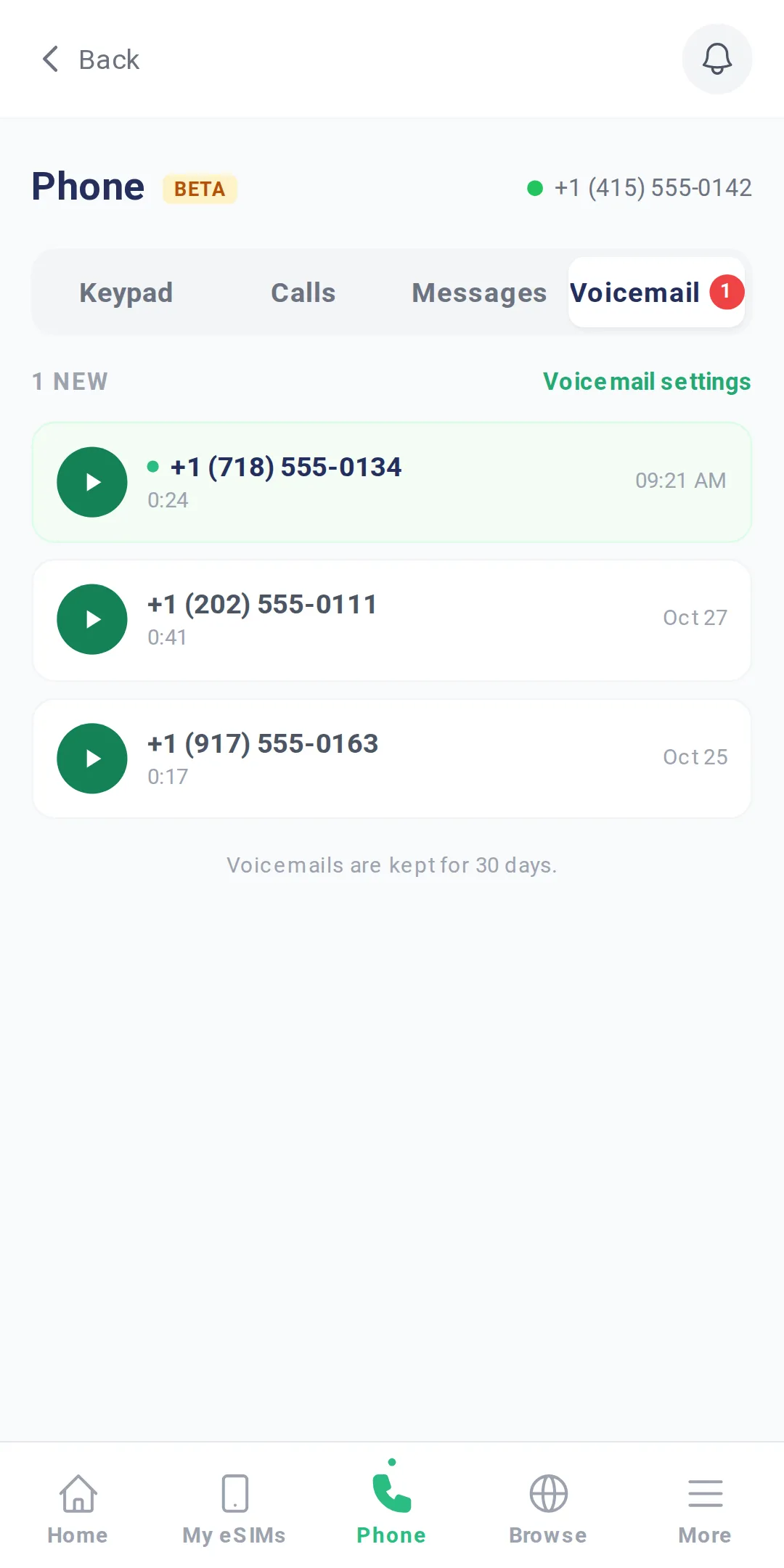
- 8:30 p.m., before the shift. Open the app, play voicemails left while you were off, and read any texts that came in.
- 9 to 11 p.m. (9 to 11 a.m. Eastern). First call block. US offices have just opened, so this is the best time to reach vendors and return calls.
- 11 p.m. to 3 a.m. Email, calendars, invoices and admin. Keep the app open for calls in.
- 3 to 5 a.m. (3 to 5 p.m. Eastern). Second call block, for anything that came up during the day.
- 5 a.m., end of shift. Send the client a short note: who called, what you did, what is open. Turn on do-not-disturb and let voicemail take the rest.
Protect the hours you sleep. Calls that arrive while you are off go to voicemail, and you return them in your next call block.
How many minutes does that use?
Say Joy makes 8 vendor calls a week of 5 minutes and 4 call-backs a week of 8 minutes. That is 72 minutes a week, or about 312 minutes a month, just over the 300 minutes a month to the US and Canada that the plan includes. Each outgoing call is rounded up to the next full minute; unanswered calls are free. Extra minutes cost $5 per 100 and carry over when you renew, so one pack covers the small gap for several months. Or Joy moves one call-back a week to email.
Calls vendors and customers make to Joy do not use those minutes. They come from the incoming allowance, a fair use of 300 minutes a month. The 300-minute guide and the cost calculator work out your own numbers.
What should your voicemail greeting say?
Most US calls in your daytime will reach voicemail, so the greeting does a lot of work. Name the client’s business, your name, your hours in their time zone and when you call back:
You have reached Joy at Harbor Lane Properties. I return calls Monday to Friday, 9 a.m. to 5 p.m. Eastern. Please leave your name, number and what it is about, and I will call you back the same working day.
Voicemail messages can be up to 2 minutes, up to 30 a month, and are kept 30 days. TripoSIM says calls ring even when the app is closed once notifications and the microphone are allowed; a phone that is off, offline or has notifications blocked does not ring, and callers reach voicemail. The voicemail guide has setup steps, and our greeting scripts give more wording.
Should you keep one number per client?
If you work for two or three US clients, yes, it helps. The same person can have as many TripoSIM US numbers as they like on one account, each with its own plan, minutes and voicemail greeting. A vendor who calls back hears the right business name, and you know which client a call is for before you answer. Each number has its own 300 outgoing minutes, so count each client’s calls on their own.
When a contract ends, turn off the renewal for that number. After the paid period it is kept 30 days on the yearly plan or 90 days on the monthly plan, then released. If the client’s customers will keep calling after you leave, a line the client owns is a better fit. The virtual assistants page compares the client’s line with your own.
What should you say about where you are?
The truth. A US area code makes you easy to call; it does not put you in the client’s office. “I work remotely from Manila” is a fine answer if anyone asks. The number is for personal and small-business use, and call centers are not allowed, so do not connect it to a dialer or share one number across a VA team.
What should you check before you rely on it?
- Your connection. The number runs in an app over Wi-Fi or mobile data. Keep mobile data as a backup for power or internet cuts, and give clients email as the fallback.
- Local rules. Rules on internet calling differ by country. Check with your regulator or mobile operator before you rely on calls.
- Texts. The number receives texts from US and Canadian senders and verification codes from apps, but sending texts is not included. Write “call or email” in your signature.
- A test run. The ten-check reliability test covers calls in and out, a locked screen and voicemail.
The bottom line
From Manila, New York’s working day is your night: 9 p.m. to 5 a.m. in the US summer, an hour later in the US winter. Put your call blocks at the start and end of that shift, let voicemail cover the hours you sleep, and agree with each client what happens when US clocks change. A US number per client keeps the calls and greetings apart. The plans page has both plans: $100 a year or $12.99 a month.