Parents call a familiar +1 number about lessons and schedules. You answer in an app between classes, or call back later.
Short answer
Online tutors and teachers outside the US use a US virtual number so parents can call a familiar +1 number about scheduling and progress. The TripoSIM number rings in an app, takes voicemail while you teach or sleep, and includes 300 minutes a month of calls to the US and Canada. Keep the lessons themselves on your teaching platform.
Why give US parents a US number?
Parents of younger students like to talk to the tutor before they pay, and again when something changes: a missed lesson, a new exam date, a question about progress. Many US parents will not dial an international number. They are unsure of the cost, or they simply do not know the dialing code. A +1 number makes that first call easy.
The TripoSIM US Virtual Number runs in an app on your phone over Wi-Fi or mobile data. It keeps parent calls apart from your personal number, and you can mute it outside your working hours. When you are teaching or asleep, callers leave a voicemail.
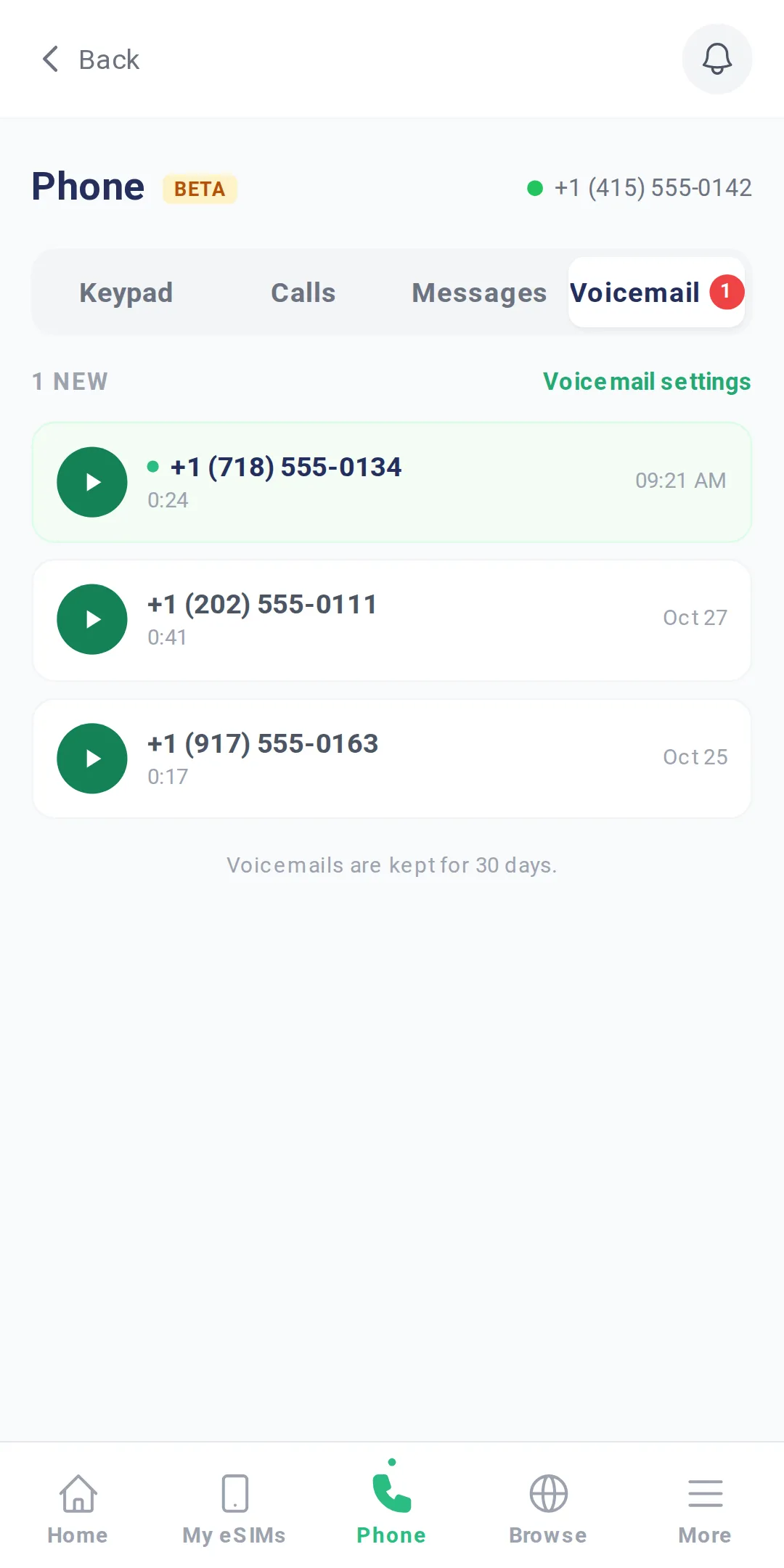
Parent voicemails you play between lessons. Real app screen, example number.
Who should call the number?
Parents and guardians: trial lessons, scheduling, payments and progress.
Adult learners: test prep, language or professional courses, where the learner is your client.
School or program staff: if you teach for a US school or program that asks for a contact number.
The number is for talking about lessons. The lessons themselves belong on your video tool or teaching platform.
How do you keep students safe?
If you teach children, the parent is your contact, not the child. A few habits protect your students and you:
Talk to parents, not children. Give the number to parents and guardians, and do not ask a student under 18 to call you privately.
Keep lessons and lesson messages on the platform. If you teach through a platform, read its rules on sharing contact details before you give out any number, and follow them.
Keep a simple log. Note the date, who called and what was agreed, and keep children's personal details out of it.
Recording needs consent. The number does not include call recording. If you record lessons with another tool, get consent and follow the rules where you and the family live.
Which lesson times work across US time zones?
US students are free after school and on weekends. Here is what two common slots in New York time mean where you are, in the US winter (early November to mid-March), when New York is UTC-5:
Two common US lesson slots in your local time, US winter
You are in
Weekdays 4 to 7 p.m. ET
Saturday 9 a.m. to noon ET
UK
Weekdays 4 to 7 p.m. ET9 p.m. to midnight
Saturday 9 a.m. to noon ET2 to 5 p.m.
Central Europe
Weekdays 4 to 7 p.m. ET10 p.m. to 1 a.m.
Saturday 9 a.m. to noon ET3 to 6 p.m.
UAE
Weekdays 4 to 7 p.m. ET1 to 4 a.m. (next day)
Saturday 9 a.m. to noon ET6 to 9 p.m.
India
Weekdays 4 to 7 p.m. ET2:30 to 5:30 a.m. (next day)
Saturday 9 a.m. to noon ET7:30 to 10:30 p.m.
Philippines
Weekdays 4 to 7 p.m. ET5 to 8 a.m. (next day)
Saturday 9 a.m. to noon ET10 p.m. to 1 a.m.
In the US summer, the times are one hour earlier in the UAE, India and the Philippines. In the UK and Central Europe they stay the same, except for a few weeks in March and around the end of October, when clocks change on different dates. West Coast families are three hours behind New York, so their after-school hours land later in your day; from the Philippines in the US winter, 4 to 7 p.m. PT is 8 to 11 a.m. the next day. The US time-zone clock shows each zone right now.
Always write lesson times with the zone, such as "Tuesday 5 p.m. ET". If you list your own time next to it, families can check the conversion themselves.
What should your voicemail say?
Parents often call during your night. Tell them when you are available and when you call back:
"Hi, you have reached [your name], math tutor. I return calls Monday to Friday between 8 and 10 a.m. Eastern. Please leave your name, your child's first name and the best time to call. For lesson changes, email works best."
Messages can be up to 2 minutes, up to 30 a month, kept 30 days. The voicemail guide covers setup and alerts.
What about texts from parents?
The number receives texts from US and Canadian senders, so a parent can text "running late, can we start at 5:15?" and you will see it. Sending texts is not included, so you cannot answer from the number. Agree on email or your platform's messages for written questions, and say so in your welcome note: "Call or email me", not "call or text me".
Are the minutes enough?
For most tutors, yes, because the calls are short. Calls parents make to you are included up to a fair use of 300 minutes a month. Only calls you place use the 300 outgoing minutes. Each outgoing call is rounded up to the next full minute; unanswered calls are free. Three typical rosters, worked out for a year:
300 min included
Scheduling callsabout 87 min, within the plan
Plus progress callsabout 267 min, within the plan
A full rosterabout 474 min: 21 extra packs, +$105 a year
Within the included minutesExtra minutes, $5 per 100
Calls a tutor places to parents, by roster size
Example
Calls out to the US and Canada
Extra minutes
One year on the yearly plan
Scheduling calls
Calls out to the US and Canada4 calls a week, 5 minutes each: about 87 minutes a month
Extra minutesNone: within the included minutes
One year on the yearly plan$100
Plus progress calls
Calls out to the US and Canadathe same, plus a 15-minute call with 12 parents each month: about 267 minutes a month
Extra minutesNone: within the included minutes
One year on the yearly plan$100
A full roster
Calls out to the US and Canada8 short calls a week of 5 minutes, plus 20 progress calls a month of 15 minutes: about 474 minutes a month
Extra minutes21 × $5 = $105 a year
One year on the yearly plan$205
Incoming calls do not use your minutes (fair use 300 minutes a month). Each plan includes 300 minutes a month out; extra minutes are $5 per 100, and unused extra minutes carry over to the next month, so the year counts the packs for all 12 months together. Prices before tax.
The monthly plan is $12.99 with the same minutes, which suits a summer or exam season. Try your own numbers in the cost calculator.
A setup checklist
Pick an area code where most of your families live. See the area code list.
Record the greeting with your call-back hours in ET or PT.
Turn on notifications and the microphone. TripoSIM says calls then ring even when the app is closed.
Turn on do-not-disturb during lessons and at night, and let voicemail answer.
Add the number to your welcome email and invoice, next to your email address.
When is another option better?
Parents expect you to text back: the TripoSIM number receives texts only. A provider with two-way texting suits you better; see providers compared.
You teach lessons by phone call: long phone lessons use minutes fast. Run them on video instead.
A tutoring center shares one line: the number is for personal and small-business use, and call centers are not allowed. A business phone system built for teams fits better.
Your families are outside the US and Canada: calls out go to US and Canadian numbers only.
Get your US number
Two plans with the same number, minutes and app.
Best value, save 36%
Yearly plan
$100per year
About $8.33 a month, paid once a year
300 minutes a month to the US and Canada
Incoming calls, voicemail and texts from US senders
Prices in US dollars as published by TripoSIM. Payments are not refunded, except a full refund if your ID check fails or your number is not delivered within 72 hours, or where local law requires. Checkout continues on TripoSIM. Right after payment you complete an ID check with a selfie, then choose from the numbers available.