A US number for translators and interpreters with US clients
US agencies and clients call a familiar +1 number about jobs and deadlines. You answer in an app, or call back in their hours.
Short answer
Translators and interpreters outside the US use a US virtual number so US agencies and direct clients can call a familiar +1 number about jobs, quotes and deadlines. The TripoSIM number rings in an app, takes voicemail and includes 300 minutes a month of calls to the US and Canada. It receives texts but cannot send them.
Illustration. The phone screen is drawn, not the TripoSIM app.
Why give US agencies and clients a US number?
Most translation work arrives by email or through an agency portal. The phone matters at the edges: a project manager with a rush job who wants a yes in five minutes, a vendor manager checking your availability, or a direct client who wants to talk through a document before asking for a quote. A +1 number makes those calls ordinary US calls for them.
The TripoSIM US Virtual Number runs in an app on your phone over Wi-Fi or mobile data. Calls ring like a normal call, wherever you work. When you are deep in a file or asleep, callers leave a voicemail.
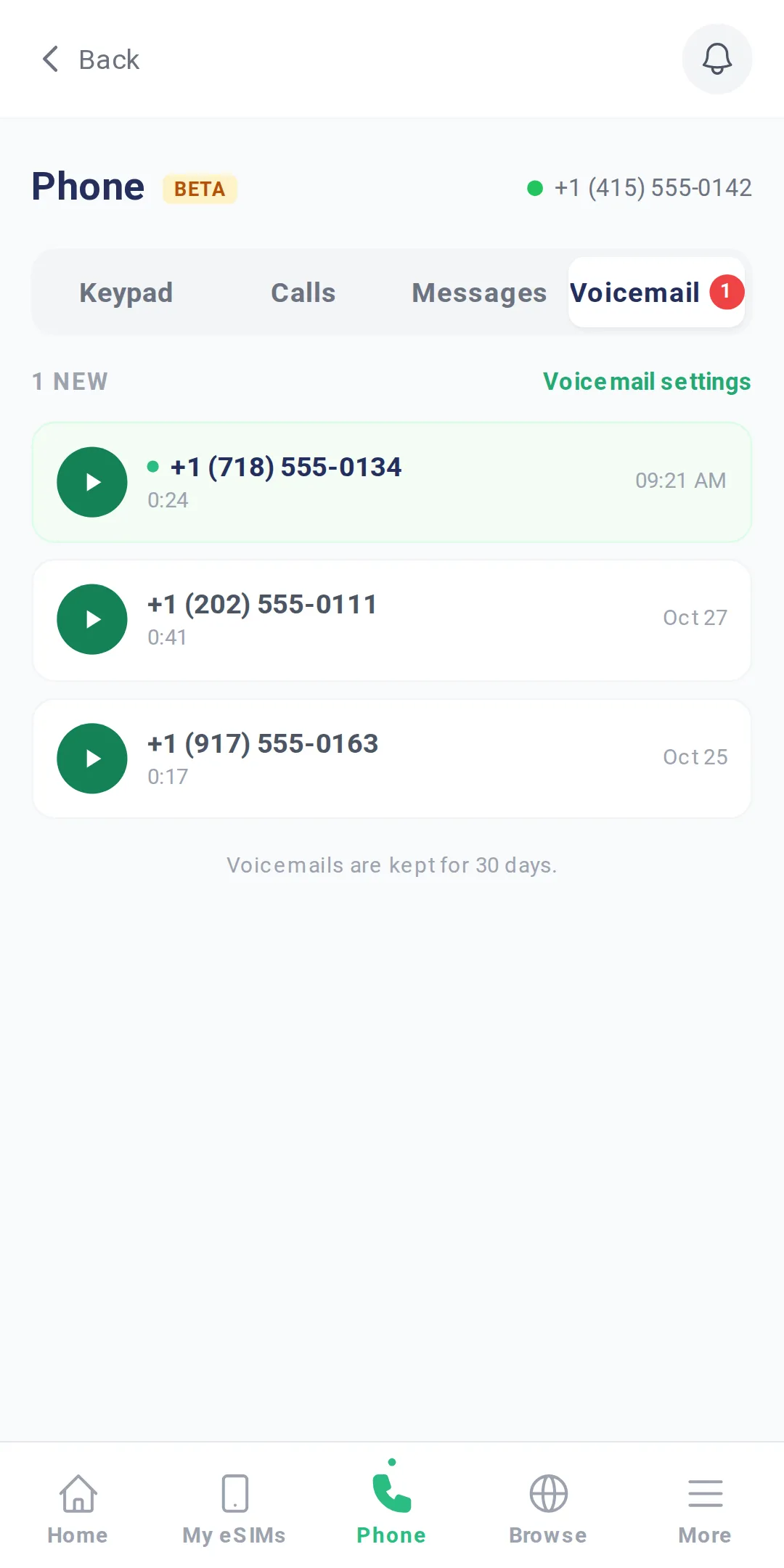
Job calls you missed, ready to play. Real app screen, example number.
Who calls you, and what do they need?
A few kinds of callers, in a typical freelance week. This is an example, not a rule for every agency:
Who calls a freelance translator, and what works
Caller
Typical reason
What works
Agency project manager
Typical reasonA new job, a deadline change or a question about a file
What worksAnswer in your hours, or play the voicemail and call back the same day
Agency vendor manager
Typical reasonOnboarding, rates or your availability next month
What worksA call-back at a time you agree, in their time zone
Direct client
Typical reasonA quote, the scope of a document or the delivery format
What worksA short call, then the quote in writing by email
Confirm every job you accept by phone with a short email, so both sides have the details in writing.
How do you schedule across time zones?
Write your call hours in a US time zone, for example "Monday to Friday, 9 a.m. to noon ET". Then pick a window that is also sane for you:
Central Europe: New York's 9 a.m. to noon is about 3 to 6 p.m. your time.
India: about 6:30 to 9:30 p.m. in the US summer, an hour later in the US winter.
West Coast clients: Los Angeles is three hours behind New York, so their morning falls later in your day.
US clocks change on the second Sunday in March and the first Sunday in November, according to NIST. Europe changes on different dates, so for a few weeks each spring and autumn the gap shrinks by an hour. The best time to call US clients has the dates and more countries, and the US time-zone clock shows the time in each zone right now.
Put both time zones in every deadline you confirm: "Delivery Thursday 5 p.m. ET (11 p.m. in Berlin)". A deadline written in one zone only is easy to misread.
What should your voicemail say?
Say your name, your language pairs, your hours in US time and what callers should leave. For example:
"You have reached [your name], Spanish and Portuguese to English translation. I take calls Monday to Friday, 9 a.m. to noon Eastern. Leave your name, your agency or company, the language pair and the deadline, and I will call you back the same working day. You can also email [your address]."
Messages can be up to 2 minutes, up to 30 a month, kept 30 days. Ask callers to send files and job details by email or the agency portal, not in a voicemail. The voicemail guide has setup steps.
Are the minutes enough for call-backs?
Calls agencies and clients make to you are included up to a fair use of 300 minutes a month. Only calls you place use your 300 minutes to the US and Canada. Each outgoing call is rounded up to the next full minute; unanswered calls are free. Three typical patterns, worked out for a year:
300 min included
A few agenciesabout 109 min, within the plan
Plus direct clientsabout 283 min, within the plan
Long project callsabout 390 min: 11 extra packs, +$55 a year
Within the included minutesExtra minutes, $5 per 100
Calls you place to US agencies and clients, by how you work
Example
Calls out to the US and Canada
Extra minutes
One year on the yearly plan
A few agencies
Calls out to the US and Canada5 call-backs a week, 5 minutes each: about 109 minutes a month
Extra minutesNone: within the included minutes
One year on the yearly plan$100
Plus direct clients
Calls out to the US and Canadathe same, plus 2 quote calls a week of 20 minutes: about 283 minutes a month
Extra minutesNone: within the included minutes
One year on the yearly plan$100
Long project calls
Calls out to the US and Canada3 calls a week, 30 minutes each: about 390 minutes a month
Extra minutes11 × $5 = $55 a year
One year on the yearly plan$155
Incoming calls do not use your minutes (fair use 300 minutes a month). Each plan includes 300 minutes a month out; extra minutes are $5 per 100, and unused extra minutes carry over to the next month, so the year counts the packs for all 12 months together. Prices before tax.
The monthly plan is $12.99 with the same minutes. If long project calls are common, move them to video and keep the phone for short calls. Try your own numbers in the cost calculator.
Is it a phone interpreting line?
No. The TripoSIM number is one person's line for ordinary calls in and out. It is not set up as an interpreting platform, and call centers are not allowed. If an agency books you for phone or video interpreting, join through the platform the agency gives you. Keep your US number for job calls, scheduling and call-backs.
What about texts and job alerts?
The number receives texts from US and Canadian senders, but sending texts is not included. If an agency offers jobs by text and asks you to reply to accept, you cannot do that from this number. Ask them to reach you by email, through their portal or with a call, and write "call or email" on your profile and website.
The number also receives verification codes (OTP SMS) from apps. TripoSIM tested Upwork, Fiverr, PayPal, Payoneer and Wise, so sign-in codes for those work and payment accounts can come to it. See a US number for Upwork and Fiverr.
Do you work under two names?
Do you run a translation business and a separate subtitling business under another name? The same person can have as many TripoSIM US numbers as they like on one account, each with its own plan, minutes and voicemail greeting, so each business answers with its own name.
When is another option better?
Agencies expect text replies from the number: the TripoSIM number receives texts only. A provider with two-way texting suits you better; see providers compared.
You interpret by phone: use the platform the agency or client gives you for sessions. This number is not an interpreting platform.
A team of linguists shares one line: the number is for personal and small-business use. Call queues and shared lines need a business phone system built for teams.
Your clients are mostly outside the US and Canada: calls out go to US and Canadian numbers only. Anyone can still call your number.
Get your US number
Two plans with the same number, minutes and app.
Best value, save 36%
Yearly plan
$100per year
About $8.33 a month, paid once a year
300 minutes a month to the US and Canada
Incoming calls, voicemail and texts from US senders
Prices in US dollars as published by TripoSIM. Payments are not refunded, except a full refund if your ID check fails or your number is not delivered within 72 hours, or where local law requires. Checkout continues on TripoSIM. Right after payment you complete an ID check with a selfie, then choose from the numbers available.