A US number for researchers and academics with US partners
US colleagues, departments and conference organizers call a familiar +1 number. You answer in an app, or call back in their hours.
Short answer
Researchers, lecturers and PhD students outside the US use a US virtual number so US colleagues, university offices and conference organizers can call a familiar +1 number. The TripoSIM number rings in an app, takes voicemail and includes 300 minutes a month of calls to the US and Canada. It receives texts but cannot send them.
Illustration. The phone screen is drawn, not the TripoSIM app.
Why give US colleagues a US number?
Most collaboration with US universities runs through email, shared documents and video calls. The phone matters for the quick things: a co-author with one question between classes, a department administrator sorting out a payment or a room booking, a conference organizer moving your session, or a landlord before a visiting term. For them a +1 number is an ordinary call, and it fits in your email signature next to your university address.
The TripoSIM US Virtual Number runs in an app on your phone over Wi-Fi or mobile data, next to your local SIM. Calls ring like a normal call. When you are teaching or asleep, callers leave a voicemail. This page covers the phone line only.
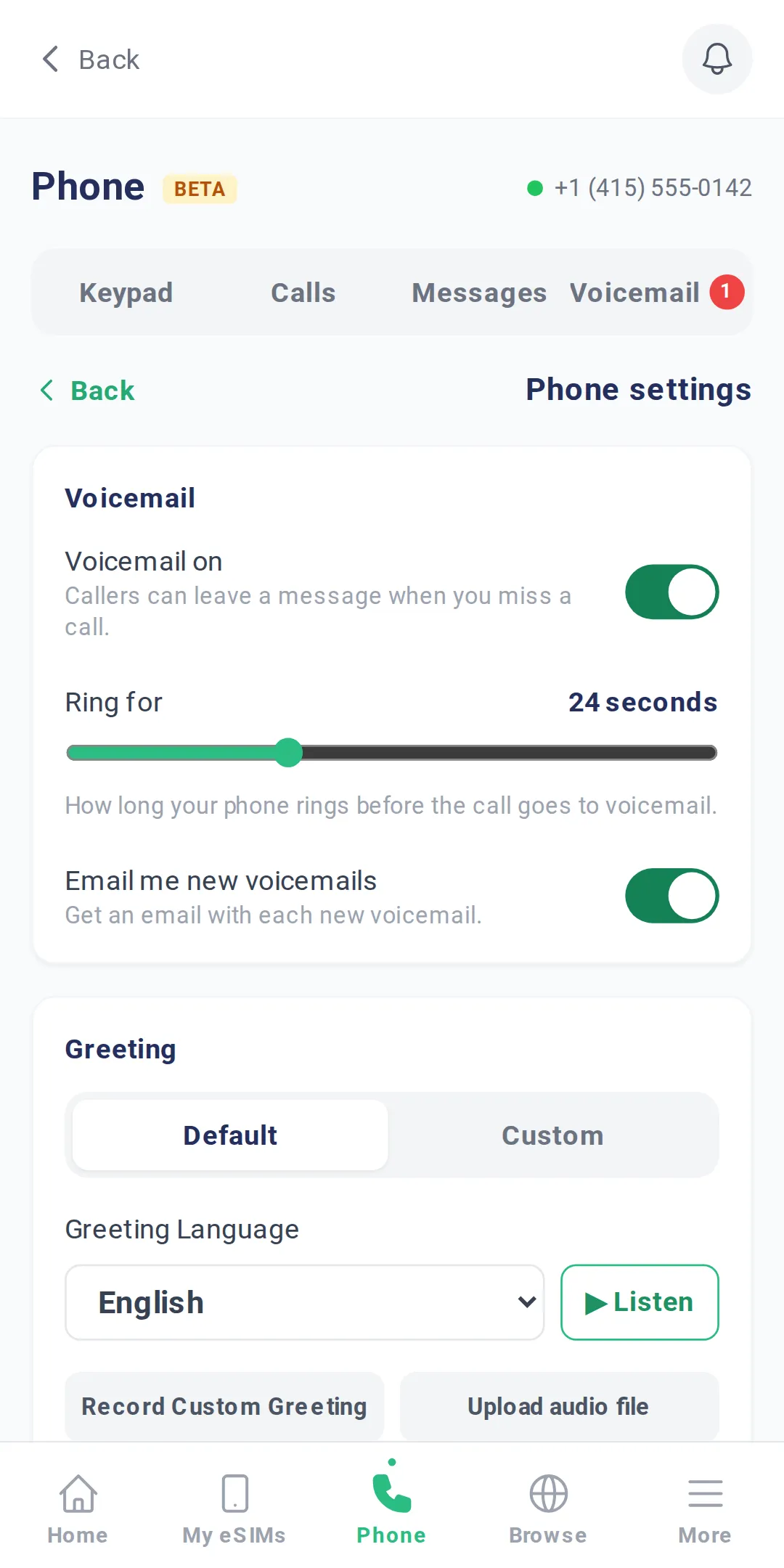
Voicemail alerts by email, handy across time zones. Real app screen, example number.
Who calls you, and what do they need?
A few kinds of callers in a typical year of US collaboration. This is a made-up example, not a rule for every university:
Who calls a researcher with US partners, and what works
Caller
Typical reason
What works
US co-author or co-investigator
Typical reasonA quick question on a draft, the data or a deadline
What worksThe phone for quick questions, video for working sessions
Department or program administrator
Typical reasonA form, a payment to you or a room for your talk
What worksA short call, then confirm what you agreed by email
Conference organizer
Typical reasonYour session time, a panel change or travel details
What worksAnswer in your call hours, or call back from the voicemail
Host department for a visit
Typical reasonArrival dates, a desk, a library card or an ID badge
What worksFollow their written instructions, and use calls for quick questions
Landlord or housing office for a visiting term
Typical reasonA viewing, a lease or a move-in date
What worksA call-back in their hours, then the details by email
Write down anything you agree on a call in a short email afterwards, so both sides have a record.
How do you schedule across time zones?
Write your call hours in a US time zone, for example "Monday to Thursday, 9 a.m. to noon ET". Then pick a window that is also sane for you:
Central Europe: New York's 9 a.m. to noon is about 3 to 6 p.m. your time.
India: about 6:30 to 9:30 p.m. in the US summer, an hour later in the US winter.
Tokyo: a colleague's 8 p.m. in New York is 9 a.m. the next day in the US summer, 10 a.m. in the US winter.
US clocks change on the second Sunday in March and the first Sunday in November, according to NIST. Europe changes on different dates, so for a few weeks each spring and autumn the gap shrinks by an hour. The best time to call US clients has more countries, and the US time-zone clock shows the time in each zone right now.
Put both time zones in every meeting you confirm: "Tuesday 4 p.m. ET (10 p.m. in Berlin)". A time written in one zone only is easy to misread.
What about conferences and visiting terms?
Put the number on conference registrations and visitor forms, so organizers and hosts can reach you before you travel. In the weeks before a visit, calls pile up: housing, the host department, a desk and an ID badge, and the people you plan to meet.
During a stay in the US, the number keeps working in the app over Wi-Fi or mobile data, and the people who know it still reach you on it. Calls out go to US and Canadian numbers only, so call colleagues elsewhere from your usual line.
What should your voicemail say?
Say your name, your field and university, your call hours in US time and what callers should leave. For example:
"You have reached [your name], [your field] at [your university] in [country]. I take calls Monday to Thursday, 9 to 11 a.m. Eastern. Leave your name, your department or conference and a good time to call, and I will call you back within one working day. You can also email [your address]."
Messages can be up to 2 minutes, up to 30 a month, kept 30 days. The voicemail guide has setup steps.
Are the minutes enough?
Calls colleagues and offices make to you are included up to a fair use of 300 minutes a month. Only calls you place use your 300 minutes to the US and Canada. Each outgoing call is rounded up to the next full minute; unanswered calls are free. Three example months, worked out as if every month looked the same:
300 min included
Ongoing collaborationabout 87 min, within the plan
Proposal deadline weeksabout 260 min, within the plan
Before a visiting termabout 434 min: 17 extra packs, +$85 a year
Within the included minutesExtra minutes, $5 per 100
Calls you place to US colleagues and offices, by how busy the month is
Example
Calls out to the US and Canada
Extra minutes
One year on the yearly plan
Ongoing collaboration
Calls out to the US and Canada1 call a week, 20 minutes: about 87 minutes a month
Extra minutesNone: within the included minutes
One year on the yearly plan$100
Proposal deadline weeks
Calls out to the US and Canada3 calls a week, 20 minutes each: about 260 minutes a month
Extra minutesNone: within the included minutes
One year on the yearly plan$100
Before a visiting term
Calls out to the US and Canadathe same, plus 4 logistics calls a week of 10 minutes: about 434 minutes a month
Extra minutes17 × $5 = $85 a year
One year on the yearly plan$185
Incoming calls do not use your minutes (fair use 300 minutes a month). Each plan includes 300 minutes a month out; extra minutes are $5 per 100, and unused extra minutes carry over to the next month, so the year counts the packs for all 12 months together. Prices before tax.
A deadline or a visit lasts weeks, not a year. Say 2 months before a visit look like the last row and the rest of the year like ongoing collaboration. Top-up minutes carry over, so 3 extra packs of 100 minutes cover it, and the year comes to $115 on the yearly plan. Long working sessions belong on video, which does not use your minutes. Try your own numbers in the cost calculator.
Only need the number around one visit? The monthly plan is $12.99 with the same minutes; if you keep it 8 months or more, the yearly plan costs less. When a plan ends, the number is kept 90 days on the monthly plan or 30 days on the yearly plan, then released. Move any account that uses the number before you let it go; the number recycling guide explains why.
What about texts and sign-in codes?
The number receives texts from US and Canadian senders, so an office's text about your visit reaches the app. Sending texts is not included, so answer with a call or an email, and write "call or email" in your signature, not "call or text".
The number also receives verification codes (OTP SMS) from apps. TripoSIM tested Google, Microsoft and LinkedIn, among others, so codes for your own accounts can come to it. University accounts follow the university's own sign-in setup; ask its IT office which methods it offers.
Do you keep two roles apart?
The same person can have as many TripoSIM US numbers as they like on one account, each with its own plan, minutes and voicemail greeting. A researcher who also consults for US companies can keep each role on its own number and greeting. In a lab, each member who needs a US line can have their own number in their own app.
Each number is still one person's line. It does not ring several people at once or queue callers.
When is another option better?
Colleagues expect text replies from the number: the TripoSIM number receives texts only. A provider with two-way texting suits you better; see providers compared.
You need a phone for emergencies during a visit: the number has no 911 or emergency calling. Keep a local mobile line during your stay.
A department or lab shares one line: the number is for personal and small-business use, and call centers are not allowed. Shared lines need a business phone system built for teams, or the university's own phone system.
Your colleagues are mostly outside the US and Canada: calls out go to US and Canadian numbers only. Anyone can still call your number.
Get your US number
Two plans with the same number, minutes and app.
Best value, save 36%
Yearly plan
$100per year
About $8.33 a month, paid once a year
300 minutes a month to the US and Canada
Incoming calls, voicemail and texts from US senders
Prices in US dollars as published by TripoSIM. Payments are not refunded, except a full refund if your ID check fails or your number is not delivered within 72 hours, or where local law requires. Checkout continues on TripoSIM. Right after payment you complete an ID check with a selfie, then choose from the numbers available.