

Say you formed a Delaware or Wyoming LLC while living in Dubai, London or Singapore. Your website is live and your first American clients are signing. Then a supplier wants to call, a client wants a quick update, and a sign-up form asks for a business phone number. One +1 number can handle all three, as long as you know which job each one is.
The three jobs a business number does
| Job | What good looks like | What to check |
|---|---|---|
| Client calls | A US client dials a +1 number and reaches you abroad | It rings on your phone when locked, and voicemail catches the rest |
| Calls to suppliers and clients | You call US and Canadian numbers without international rates | How many minutes are included and what extra minutes cost |
| Sign-up and login codes | Codes from banks, payment apps and platforms arrive when you sign up or log in | Enter the number as +1 and ten digits, and add a second login method such as a passkey |
What the TripoSIM US number includes
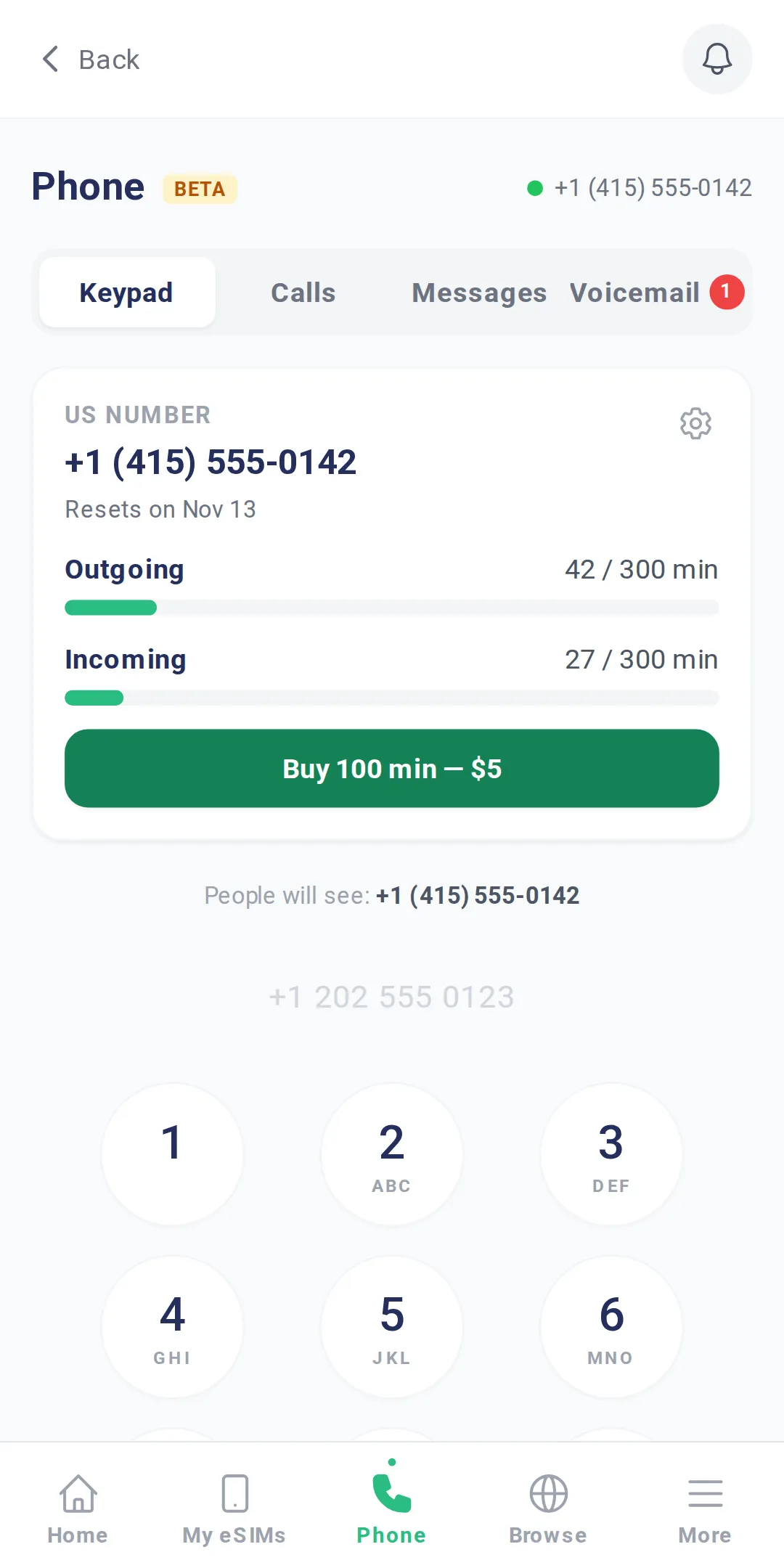
Your number lives in the TripoSIM app on your phone, next to the SIM you already have. It includes 300 outgoing minutes a month to US and Canadian numbers, incoming calls with a fair-use allowance of 300 minutes a month, voicemail, texts from US and Canadian senders, and verification codes from apps, including WhatsApp. It costs $100 a year or $12.99 a month.
It does not send texts and does not call 911. It is an app-based (VoIP) number, not a US carrier line, and it needs Wi-Fi or mobile data. After payment you complete a short ID check, then choose a number by state or area code; how it works shows each step.
A US number is not a US office
A New York or Miami area code makes you easy for clients to call. It does not mean your company operates from New York or Miami, and it should not be presented that way. Show your real business location where a site or form asks for it.
Google’s Business Profile guidelines say a rented mailing address you do not operate from, also known as a virtual office, is not eligible, and an office in a co-working space only counts if it has signage, receives customers and is staffed during business hours. A US number on its own does not make an overseas business eligible for a local listing. Company formation, tax and banking also ask for real ownership and address details, separately from your phone number.
Getting an EIN from abroad
Having a US phone number is not one of the conditions for an EIN. Whether you can apply depends on your company and its responsible party, as set out in the IRS instructions for Form SS-4.
If your company has no legal residence, principal place of business or office in the US, the IRS lets international applicants apply by phone on 267-941-1099 (not toll-free), 6 a.m. to 11 p.m. Eastern time, Monday to Friday; you can also fax or mail Form SS-4. Because that is a US number, a call from the TripoSIM app uses your included minutes rather than international rates. Check the hours on the IRS page before you call.
Bank, Stripe and PayPal codes
The number receives verification codes (OTP SMS) from apps, including bank and payment apps. TripoSIM tested 22 apps from October 3 to 18, 2026, among them PayPal, Wise, Payoneer and Stripe, and each sent its code; the verification research lists every app and date.
Getting a code is one step; opening a business account is another. The bank or payment provider still checks your company documents and your identity, and a phone number does not replace those. On every important account, add a passkey or authenticator app as well, so you can still log in if you ever change numbers.
One founder or a team?
These are worked examples, not customer results.
| Solo consultant abroad | Five-person support agency | |
|---|---|---|
| Calls out a month | 24 calls × 7 minutes = 168 minutes | 120 calls × 6 minutes = 720 minutes |
| Fits 300 included minutes? | Yes, with room to spare | No: 420 minutes over, or five top-ups of 100 |
| Several people answering one number | Not needed | Usually essential |
| Better fit | One app number with voicemail | A business phone system with call queues |
A setup that works from abroad
- Pick your hours. Overlap at least two hours with your main clients’ time zone. New York and California are three hours apart, so name the time zone instead of writing “US hours”. The US time tool shows the gap from your city.
- Publish the number honestly. Put the +1 number on your contact page with your real location, and say calls are answered over the internet.
- Test it first. Have a US contact call with your phone unlocked, then locked. Run the ten-check test before you print the number anywhere.
- Add a backup route. Offer an email address or contact form, and never let a tax, payment or legal deadline depend on one call.
- Watch your minutes. Each outgoing call is rounded up to the next full minute; unanswered calls are free. Leave room for a busy month.
- Protect the number. Note your renewal date and who checks voicemail while you travel.
A contact block you can copy:
US phone: +1 (your number) Call hours: Monday to Friday, 9 a.m. to 1 p.m. Eastern Time Based in: (your real country or city) Or write to us: (your email or contact form)
Twelve months of cost
Eight monthly payments cost $103.92, against $100 for a year; seven cost $90.93. So if you will keep the number 8 months or more, the yearly plan is cheaper. For a short project, monthly can still make sense. The plans page compares both.
The bigger cost is usually elsewhere: a missed client call, or a number you let lapse that clients still have. Choose by the job the number must do, not by the price alone.
Seven questions before you buy
- Can US clients call the number and reach me in the country where I live?
- Do I call both the US and Canada, and how many minutes a month?
- Does the app ring on my phone when it is locked?
- Do I only need to receive texts, or must I text clients back?
- Which accounts will send codes to this number, and do they have a second login method?
- What happens to the number if I stop paying?
- Am I one person, or do several people need to answer the same number?