

Cape Town agencies build websites for clients in New York, remote workers in Johannesburg sit on US payrolls, safari and Winelands tour operators sell trips through American travel agents, and a lot of South African families have a son or daughter working in Houston or studying in Atlanta. All of them share one thing: the American side of the conversation starts in your afternoon. Here is how the hours line up, how a US number fits each case, and how the minutes work when work and family share one line.
When does South Africa overlap with the US?
In your afternoon and evening. South Africa is UTC+2 all year and does not change its clocks (IANA). US Eastern time is UTC-4 in the US summer and UTC-5 in the US winter, Central is an hour behind Eastern and Pacific three hours behind, and the US summer runs from the second Sunday in March to the first Sunday in November (NIST).
The seasons are reversed, so read the columns by US season: “US summer” here is your winter, and “US winter” is your summer.
| Your client is in | US summer, South Africa time | US winter, South Africa time |
|---|---|---|
| Eastern (New York, Boston, Atlanta) | 3 p.m. to 11 p.m. | 4 p.m. to midnight |
| Central (Chicago, Dallas, Houston) | 4 p.m. to midnight | 5 p.m. to 1 a.m. |
| Pacific (Los Angeles, San Francisco, Seattle) | 6 p.m. to 2 a.m. | 7 p.m. to 3 a.m. |
So the working window for the East Coast is 3 to 6 p.m. in the US summer and 4 to 7 p.m. in the US winter, which is 9 a.m. to noon in New York. The West Coast’s morning lands in your evening, 6 to 8 p.m. or 7 to 9 p.m. That suits family calls well: a call at 7 p.m. in Cape Town reaches Atlanta at 1 p.m. in the US summer and at noon in the US winter.
US clocks go back on November 1, 2026 and forward on March 14, 2027. Right now, in your summer, New York is seven hours behind you; from mid-March it is six. The US time-zone clock shows each zone right now.
Does an app-based US number work in South Africa?
The TripoSIM US Virtual Number runs in the TripoSIM app over Wi-Fi or mobile data. On iPhone, add the TripoSIM web app to your Home Screen. On Android, install the TripoSIM app. You sign up with an email address, a payment card and a short ID check with a photo ID and a selfie, about 2 minutes, and you do not need a US address or an SSN.
- Rules differ by country. On your network, a call on the number is an internet call. Before you rely on calls, check the rules on internet calling with your regulator or mobile operator, and keep your South African SIM for calls at home.
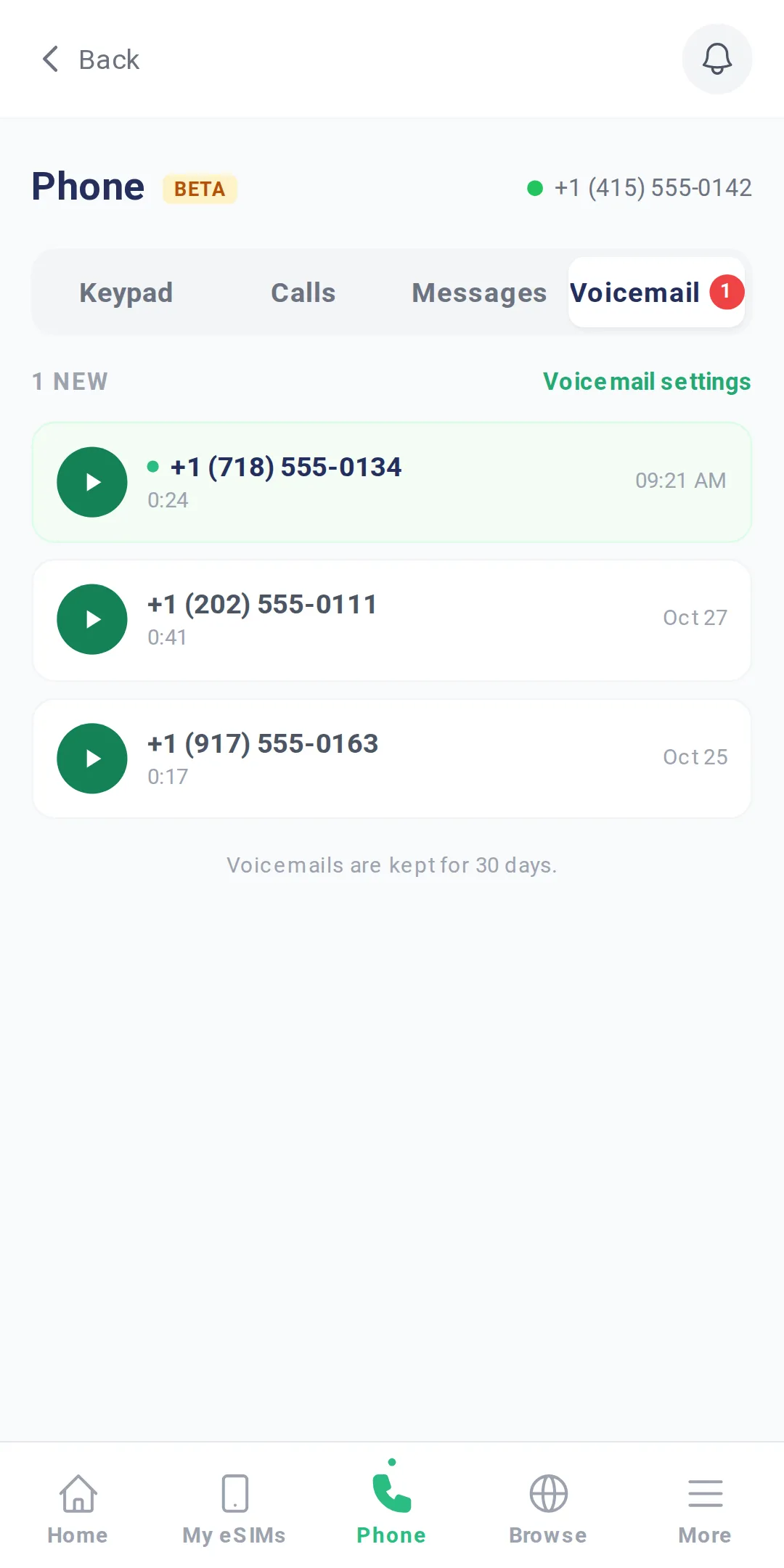
Texts work differently. A text from a US sender reaches your number in the US and appears in the app over your connection, and verification codes from apps arrive the same way. TripoSIM says calls ring even when the app is closed once notifications and the microphone are allowed; a phone that is off, offline or has notifications blocked does not ring, and callers reach voicemail.
Who in South Africa uses a US number?
- Agencies. Give each account manager their own number, app and ID check, so a client in New York reaches the person who knows their project. One person can also hold several numbers, each with its own plan, for example one per client brand. The agencies page has the options.
- Remote workers and freelancers. A +1 number on your profile and email signature lets a US manager call you between meetings. The number also receives verification codes (OTP SMS) from apps: Upwork, Payoneer and Wise sent codes in TripoSIM’s tests on October 3, 2026. Keep your profiles set to your real country. See the freelancers page.
- Safari and wine tour operators. American travel agents and guests can call a +1 number about a Kruger lodge or a day in Stellenbosch without an international call. Voicemail takes the calls that arrive after your office closes. The tour operators page covers inquiry lines.
- Families. Children, siblings or parents in the US call a local +1 number instead of an international one, and you call them back with the included minutes. The families page has more examples.
How do the minutes work when work and family share a line?
There are two separate allowances. Calls you make to US and Canadian numbers use your 300 minutes a month. Calls people make to you come from a fair use of 300 minutes a month. Each outgoing call is rounded up to the next full minute; unanswered calls are free.
Take Thandi, a made-up example: she runs a small wine-tour company in Stellenbosch, and her daughter studies in Atlanta. Each week she has three 15-minute calls with US travel agents and calls her daughter once for 20 minutes. That is 65 minutes a week, or about 280 minutes a month, inside her outgoing minutes. Her daughter calls her every Sunday for half an hour, and guests call with questions; those minutes come from the incoming allowance, not from her 280. In a month with more agent calls, extra outgoing minutes cost $5 per 100. The cost calculator works out your own month.
If you would rather keep work and family apart, one person can have two numbers, each with its own plan and voicemail greeting.
What should your contact page and greeting say?
Give your hours in the caller’s time zone and say where you are:
Call us from the US: +1 (your number). (Company name), Stellenbosch, South Africa. I answer Monday to Friday, 9 a.m. to 1 p.m. Eastern. Leave a voicemail at any time with your travel dates, or email (your address), and I will call you back the same day.
Write “call or email”, not “call or text”. A US area code makes you easy to call; it does not give you a US office, so name your real town. Messages can be up to 2 minutes, up to 30 a month, kept 30 days. The voicemail guide covers setup.
What can’t the number do?
- No sending texts. It receives texts only. For chat, clients and family can use email or WhatsApp, which you can set up on the same US number.
- No calls to South African numbers. Calls out go to US and Canadian numbers only, so keep your local line for local calls.
- No 911. It cannot call 911 or any emergency service, so keep your South African number for emergencies.
- Not a team line. It is one person’s line for personal and small-business use, and call centers are not allowed.
The bottom line
From South Africa, call New York between about 3 and 7 p.m., depending on the US season, and the West Coast in your evening. Publish a +1 number with your hours in Eastern time and “call or email”, give it to family in the US, and keep mobile data ready for when the Wi-Fi drops. Check the rules on internet calling first, then test calls with the ten-check reliability test. The plans page has both plans: $100 a year or $12.99 a month.